Best Weather Sealed FPV Drone by Frame and Flight Time

None of these six listings publishes an ingress rating, so weather sealing stays an open question. Here's what the published specs do settle: frame material, flight time claims, and which kit puts you in goggles the same afternoon.

By Travis WaltersUpdated 16 min read
On this page
- Best weather sealed FPV drone at a glance
- How I screened these six listings
- Does any of these actually claim weather sealing?
- Ready-to-fly kit or camera drone: which decides it?
- 1. BETAFPV Aquila20 FPV Kit with LiteRadio 4 VR04 — Best overall
- 2. BETAFPV Cetus Pro FPV Kit — Runner-up
- 3. ALORELS Drone with Camera for Beginners — Best upgrade
- 4. SJsharp Drone with Camera for Adults LCD Screen FPV Live — Best minimal setup
- 5. YETEETH 8Pcs Propellers Replacement for DJI FPV — Best for pros
- 6. GIGEGAIRC (8 Pcs) FPV Propellers Blades Replacement for — Best budget pick
- What spare props tell you about a category
- When a different pick wins
- The verdict
- FAQ
The best weather sealed FPV drone in this set is the BETAFPV Aquila20 FPV Kit, which pairs a PA410 impact-absorbing frame with a claimed 10-minute flight on 2S power in a 5.5 x 10.4 x 8.7 in box. If you'd rather have altitude hold and turtle mode, the BETAFPV Cetus Pro kit is the better buy. Get this wrong and the failure mode is expensive: a drone that dies on its third damp landing, or a set of props that never fits the airframe you own.
Best weather sealed FPV drone at a glance
| Pick | Frame / body | Flight claim | Price |
|---|---|---|---|
Best overall BETAFPV Aquila20 FPV Kit |
PA410 impact frame claim | 10 min on 2S claim | Check Price |
Runner-up BETAFPV Cetus Pro FPV Kit |
Brushless whoop, 3.09 lb kit | Altitude hold claim | Check Price |
Best upgrade ALORELS Drone with Camera |
Foldable, 2.5 x 8.9 x 6.5 in | 24–28 min, two batteries | Check Price |
Best minimal setup SJsharp Drone with LCD Screen |
Foldable, 6.35 oz | Modular battery claim | Check Price |
Best for pros YETEETH 8Pcs Propellers |
8 props, 2.89 oz total | Spare part, no flight | Check Price |
Best budget pick GIGEGAIRC 8 Pcs FPV Propellers |
8 props, 0.39 in blade | Spare part, no flight | Check Price |



How I screened these six listings
I lined up the published specifications side by side and threw out everything I could not read off a listing. That is a stricter filter than it sounds, because this category is full of marketing adjectives and short on numbers.
Three things survived the cut:
- Frame and body figures. Dimensions, weight, colour, count. The Cetus Pro kit publishes a 3.09 lb shipping weight and a 14-piece count. The SJsharp lists 6.35 oz. Those are comparable.
- Flight-time claims, clearly attributed. BETAFPV says the Aquila20 gets 10 minutes on a 2S HV 1100mAh battery. ALORELS says 24–28 minutes across two packs. Neither is a measurement I made.
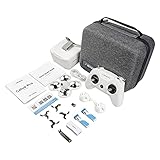
- What is actually in the box. The Aquila20 arrives with VR04 goggles and a LiteRadio 4 SE transmitter. The Cetus Pro arrives with VR02 goggles and a LiteRadio 2 SE. The props arrive as eight props and nothing else.
What got cut was every claim I could not tie to a figure. "Crash-resistant" is a direction, not a number. And here is the awkward part of writing a best weather sealed FPV drone guide from listing data: not one of these six publishes an IP code.
Does any of these actually claim weather sealing?
No. That is the honest answer, and it changes how you should read the rest of this best weather sealed FPV drone roundup.
Amazon's search returned these six for the query, but the qualifier is doing nothing. Search the listings for an ingress rating and you find a PA410 frame claim, a foldable body, an over-current protection claim, and two sets of plastic props. None of that is sealing. An IP54 body and a bare-board flight controller can share a marketing phrase and behave completely differently in mist.
So judge it yourself, on the listing, before you buy:
- Look for a two-digit IP code. IP is a standardised ingress rating. A number after it means something; the word "durable" does not.
- Check whether the manufacturer names the sealing method. Conformal coating, gasketed shells, potted motors. Silence usually means none.
- Treat spare props as unsealed by definition. They're moving plastic.
- Assume a tiny whoop-class drone is an indoor and dry-day machine unless the brand says otherwise in writing.
What you can lean on instead is impact tolerance, because a bad landing is far more likely than a rainstorm. BETAFPV says the Aquila20's PA410 frame is designed to absorb impact, and that is the closest thing in this set to a durability specification.
Ready-to-fly kit or camera drone: which decides it?
Most guides to the best weather sealed FPV drone compare camera resolution. That is not what decides it. What decides it is whether you're flying through goggles or looking at a screen, because those are two different hobbies wearing the same three letters.
Goggle flying puts you inside the aircraft. Two picks here do that as a complete package: the Aquila20 with VR04 goggles, and the Cetus Pro with VR02 goggles. Both include a transmitter, so nothing is missing on day one.
Screen flying keeps you outside it. The ALORELS sends 1080p to a phone with a camera BETAFPV's rivals don't match, tiltable forward or down by app, remote or hand. The SJsharp skips the phone entirely with a 2.8-inch display on the controller.
The cutoff is airtime versus immersion. Under roughly 15 minutes of claimed flight, you're in whoop territory: short hops, goggles on, a stack of batteries. Above 20 minutes, you're in camera-drone territory, and the ALORELS pair of batteries covering 24–28 minutes is the only listing here that clears it.
1. BETAFPV Aquila20 FPV Kit with LiteRadio 4 VR04 — Best overall
The Aquila20 is the pick that puts you in goggles the same afternoon, on the longest whoop-class flight claim in this set.
Best for: a first-time pilot who wants goggles, radio and drone in one box Skip it if: you need a documented ingress rating before you fly
What separates this from the other five listings is completeness plus a stated frame material. BETAFPV says the kit ships with the Aquila20 whoop, the VR04 goggles and the LiteRadio 4 SE transmitter, which means no separate radio purchase and no binding puzzle. The goggles are described as glasses-friendly with one-button recording and up to 2 hours of standby, though the micro card is excluded. That last detail matters. Buy a card at the same time.
The frame claim is the part I keep coming back to. PA410 is a named polyamide, and BETAFPV says it was chosen specifically to absorb impact. Compare that to the vaguer "foldable" and "durable" language on the camera drones. On power, the listing claims 10 minutes from a 2S HV 1100mAh smart battery across three progressive flight modes.
The trade-off against the rest of this set is straightforward: it holds the highest price position of the six, and it still publishes no sealing rating and no warranty term. You're paying for a complete FPV entry, not for weatherproofing.
Pros:
- Drone, VR04 goggles and LiteRadio 4 SE in one kit
- Named PA410 frame material, chosen for impact absorption
- 10-minute flight claim on 2S HV 1100mAh
- Three flight modes for progressive learning
- Goggles claim up to 2 hours standby
Cons:
- The most expensive pick here, with no published warranty
- No ingress rating anywhere in the listing
- Micro SD card not included despite onboard recording
- Only one seller lists it
- The slowest seller of the six by a wide margin
2. BETAFPV Cetus Pro FPV Kit — Runner-up
The Cetus Pro trades the Aquila20's longer flight claim for two safety nets a nervous beginner will actually use.

Best for: beginners who want altitude hold and turtle mode Skip it if: you want the longer 2S flight claim
This is the other complete goggle kit, and it's the more forgiving of the two on paper. BETAFPV describes it as a brushless whoop built from the ground up for FPV beginners, shipping with the LiteRadio 2 SE transmitter and VR02 goggles. The listing publishes a 14-piece count and a 3.09 lb weight, which is the heaviest figure in this roundup and reflects a fully packed box rather than a heavy aircraft.
Three claimed features do the work here. Altitude hold lets the quad auto-hover with hands off the sticks. A self-protection function is claimed to force an emergency landing on loss of control or low battery. Turtle mode is claimed to flip the drone upright after it lands inverted, which is the single most common way a beginner's session ends early.
Against the Aquila20, the losses are real. No flight time is published, no frame material is named, and the goggles are the older VR02. It also sits in the premium price position without the newer radio. Choose it when you value recovery features over airtime.
Pros:
- Complete kit with LiteRadio 2 SE and VR02 goggles
- Altitude hold claimed for hands-off hovering
- Turtle mode claimed to right an inverted landing
- Self-protection landing claim on low battery
- Sells faster than the Aquila20 here
Cons:
- No published flight time at all
- No frame material named, unlike the Aquila20
- Older VR02 goggles at a premium price position
- No stated warranty, and only one seller lists it
3. ALORELS Drone with Camera for Beginners — Best upgrade
The only pick here claiming more than 20 minutes of airtime, and the only one with a tiltable 1080p camera.
Best for: someone who wants long airtime and a tiltable 1080p camera Skip it if: you want true goggle-based FPV flying
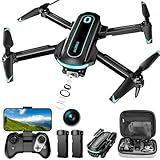
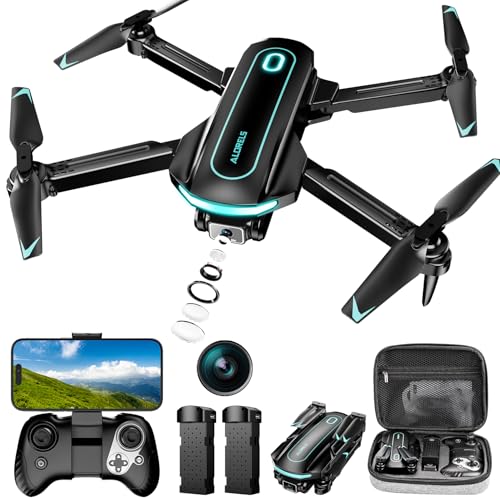
Airtime is where this listing wins outright. ALORELS claims 24–28 minutes across two rechargeable batteries, which is more than double the Aquila20's 10-minute figure. For anyone whose actual goal is footage rather than racing, that changes the shape of an afternoon.
The camera is the other differentiator. It's a 1080p FPV camera on a tilting mount, adjustable by app, by remote, or by hand, giving you a forward view or a downward one. The listing also lists over-current protection, an emergency stop, trajectory flight, gravity control, 3D flip, headless mode and a three-speed mode. ALORELS adds a calibration note: gyroscope before every flight and after every crash, both sticks held at a 45° lower corner for a couple of seconds.
Body-wise it's the flattest of the flyers at 2.5 x 8.9 x 6.5 in, folded. The trade-off is that this isn't goggle FPV in the enthusiast sense, and the listing publishes no frame material, no warranty and no sealing rating. It's a screen-flown camera drone that answers to the same acronym.
Pros:
- 24–28 minute flight claim across two batteries
- Tiltable 1080p camera, forward or downward
- Foldable at 2.5 x 8.9 x 6.5 in
- Over-current protection and emergency stop claimed
- Sits mid-range in price for the longest airtime here
Cons:
- No goggles included, so no immersive FPV out of the box
- Needs gyroscope calibration before every flight
- No frame material, warranty or ingress rating published
- Only one seller lists it
4. SJsharp Drone with Camera for Adults LCD Screen FPV Live — Best minimal setup
The screen is on the controller, so this is the one pick that never asks for your phone.

Best for: flying without a phone, using the screen built into the radio Skip it if: you want a headset rather than a 2.8-inch display
Every other camera pick here routes your video through a phone app. This one doesn't. SJsharp puts a 2.8-inch high-definition display directly on the transmitter and claims stable real-time transmission through it. If you've ever fumbled a phone clamp in the cold, you'll understand why that's worth something.
The rest of the published detail is unusually generous for this category. It weighs 6.35 oz, folds to 2.56 x 8.27 x 7.09 in, and ships in blue with a 32G SD card. SJsharp is upfront that the TT19LCD is not a 4K machine; it's an HD FPV camera on a 90° electrically adjustable mount. A 270° obstacle avoidance system is claimed, along with brushless motors, 3D flips and a modular battery.
It's also the fastest seller of the six by a clear margin. The honest weakness is that no flight time appears anywhere, which is odd given how much else is listed, and no warranty or sealing rating is published either. A 2.8-inch screen is also a long way from goggles.
Pros:
- 2.8-inch display built into the controller, no phone needed
- Lightest flyer here at 6.35 oz
- 32G SD card included in the box
- 270° obstacle avoidance and brushless motors claimed
- The one buyers choose most often in this set
Cons:
- No published flight time despite detailed specs
- Explicitly not a 4K camera
- Small screen instead of immersive goggles
- No warranty or ingress rating listed
5. YETEETH 8Pcs Propellers Replacement for DJI FPV — Best for pros
Eight spare props for a DJI FPV, with a published set weight and a model number you can match.

Best for: DJI FPV owners restocking props between sessions Skip it if: you need OEM parts
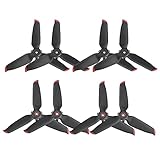
If you already own a DJI FPV, props are the consumable that decides how long a flying day lasts. This is a set of eight in black, published at 2.89 oz for the full set, under model YETEETH YS2021033007. That combination of a count, a weight and a model number is more traceable than the other prop listing manages.
YETEETH is direct about what these aren't. The listing states plainly that they are not OEM, and that they perform "almost as good as OEM Props" after pre-sale testing. I'd take that at face value: near-OEM, not OEM. A noise reduction design and easy installation are also claimed.
Two things to be clear about. This is a spare part, not an aircraft, so the sealing question doesn't apply and neither does flight time. And its price position is second-cheapest here, above the other prop set, without any published advantage in blade geometry to justify the gap. The reason it earns a place in a best weather sealed FPV drone guide is practical: props are what you replace after the crash that a durable frame survives.
Pros:
- Eight props, matching DJI FPV, in one pack
- Published set weight of 2.89 oz
- Model number listed for repeat ordering
- Noise reduction and easy installation claimed
- Second-cheapest pick in this set
Cons:
- Explicitly not OEM, by the seller's own admission
- Not a drone, so it flies nothing on its own
- Costs more than the other prop set with no published edge
- No warranty stated, and only one seller lists it
6. GIGEGAIRC (8 Pcs) FPV Propellers Blades Replacement for — Best budget pick
The cheapest of the six, and the only prop set publishing a blade dimension.

Best for: the cheapest way to keep a DJI FPV airborne Skip it if: you want a published weight for the set
This is the entry point of the whole roundup by price, and it's aimed squarely at DJI FPV Combo owners. GIGEGAIRC lists eight props with a stated blade dimension of 0.03 x 0.39 x 0.39 in, which is thickness and span rather than a shipping figure. Nobody else in the prop pair publishes that.
The claims focus on geometry and speed of fitting. GIGEGAIRC says the curvature at the blade tip improves aerodynamic efficiency and reduces damage during installation. It also describes a quick-disassembly design: align the blade with the seat, press, rotate, fasten, one second. Pre-sale testing and reduced wind resistance are claimed, along with extended endurance. Treat the endurance line as marketing, because no figure backs it.
The gaps are worth naming. The count field reads 1 while the package description says eight props, so read the package line rather than the count. No total weight is published, no model number is given, and the drone is not included. As with the YETEETH set, this is a consumable that keeps an existing airframe flying, not an answer to the sealing question.
Pros:
- The cheapest of the six picks here
- Blade dimension published at 0.03 x 0.39 x 0.39 in
- Quick-disassembly fitting claimed at one second
- Eight props per package for DJI FPV Combo
Cons:
- Count field says 1 while the package says 8 props
- No set weight and no model number published
- Endurance claim carries no supporting figure
- Not a drone, and no warranty stated
What spare props tell you about a category
Two of these six listings are propellers, which tells you something useful before you spend anything. In FPV, props are the fuse. They break so the motors and arms don't.
That reframes the durability question. A drone with a named impact-absorbing frame plus a stocked drawer of spare props will outlast a drone with vague durability language and no spares. Here's the trick with prop buying:
- Match the airframe by name, not by look. Both prop sets here specify DJI FPV. Neither fits a whoop.
- Read the package line over the count field. The GIGEGAIRC listing shows exactly why.
- Accept non-OEM openly or not at all. YETEETH states it in the listing, which is more useful than silence.
- Buy in eights. A quad needs four, and you want a full spare set in the bag.
Most shoppers miss that a prop order is the cheapest reliability upgrade in this roundup. Neither set publishes a weather rating, and neither needs to.
When a different pick wins
Three named conditions flip my recommendation away from the Aquila20:
- You crash a lot and land inverted. Turtle mode and altitude hold on the Cetus Pro will save more sessions than four extra minutes of flight will.
- You want footage, not immersion. The ALORELS 24–28 minute claim and tiltable 1080p camera beat any whoop here for filming.
- You already own a DJI FPV. Then you don't need a drone at all. You need props, and the GIGEGAIRC set is the cheapest of the six.
One more flip worth naming: if you refuse to fly without a documented ingress rating, none of these six should get your money. Keep looking, and demand an IP code in writing.
The verdict
The BETAFPV Aquila20 FPV Kit is my winner among the best weather sealed FPV drone results, and the reason is specific rather than atmospheric. It's the only pick that names its frame material, PA410, and states why that material was chosen: impact absorption. It also pairs the longest whoop-class flight claim here, 10 minutes on a 2S HV 1100mAh battery, with a complete box containing the VR04 goggles and the LiteRadio 4 SE transmitter. Nothing else to buy except a micro SD card.
Two conditions flip that. If you expect to crash often and want the drone to bail you out, the Cetus Pro's claimed altitude hold, self-protection landing and turtle mode are worth more than the extra airtime, and it sells faster than the Aquila20 here. If your real goal is video, the ALORELS listing's 24–28 minute two-battery claim and tiltable 1080p camera win outright, and it costs less than either goggle kit.
The runner-up's exact advantage is recovery, not performance. Turtle mode rights an inverted quad without you walking across a field. That's the difference between a 20-minute session and a two-hour one.
FAQ
Is a weather sealed FPV drone worth paying more for?
A weather sealed FPV drone is worth paying more for only when the listing publishes an actual IP code. None of these six does. Paying the premium price position for the Aquila20 buys you a complete goggle kit and a named PA410 impact frame, which is real value, but it does not buy documented sealing. Judge that claim listing by listing.
What does the best weather sealed FPV drone need to survive a crash?
The best weather sealed FPV drone needs a frame material you can name and spare props you can reorder. BETAFPV states the Aquila20 uses PA410 specifically to absorb impact, which is the only frame-material claim in this set. Pair that with an eight-pack of props for your airframe, and you've covered the two failure points that actually end flying days.
Aquila20 or Cetus Pro: which BETAFPV kit should I buy?
Aquila20 or Cetus Pro comes down to airtime against recovery. The Aquila20 claims 10 minutes on a 2S HV 1100mAh pack and ships with newer VR04 goggles and the LiteRadio 4 SE radio. The Cetus Pro publishes no flight time but claims altitude hold, self-protection landing and turtle mode. Nervous beginners should take the Cetus Pro.
Will these propellers fit any FPV drone I own?
These propellers fit only what the listing names. Both the YETEETH and GIGEGAIRC eight-packs specify DJI FPV airframes, and neither fits the BETAFPV whoops in this roundup. YETEETH states its set is not OEM. Check your airframe model against the listing text before ordering, because a prop that nearly fits is a prop that comes off in flight.
What is the biggest mistake buyers make in this category?
The biggest mistake buyers make is treating any drone with "FPV" in the title as goggle-ready. Only two picks here include goggles: the Aquila20 with VR04 and the Cetus Pro with VR02. The ALORELS sends 1080p to a phone, and the SJsharp uses a 2.8-inch controller screen. Those are different hobbies with the same three letters.
Start with the Aquila20 if you're buying your first FPV setup and you want to be flying in goggles the day the box arrives, because a named PA410 frame plus a 10-minute flight claim plus an included radio removes every excuse to delay. Add an eight-pack of props only once you know which airframe you're feeding. And keep the sealing question open: until a manufacturer prints a two-digit IP code on the listing, fly these on dry days and treat the "weather sealed" label in search results as a search term, not a specification.