Best Full Frame Drone: RELIDOL PK01 Leads
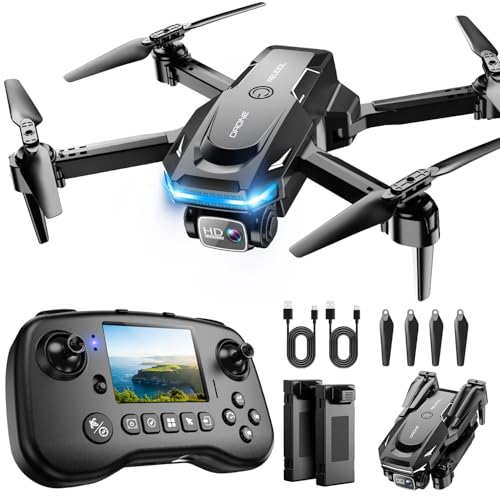
Searching for a full frame drone turns up two very different things: ready-to-fly camera quadcopters and bare carbon fiber airframes. Here's which of the five is right for you, and what the term actually buys you on Amazon.

By Travis WaltersUpdated 15 min read
On this page
- Best full frame drone at a glance
- What does full frame actually mean on a drone listing?
- How I weighted the criteria for the best full frame drone
- 1. RELIDOL Drone with Camera, Screen on Controller Remote — Best overall
- 2. VVDZJX Mini Drone with Camera for Kids — Best budget pick
- 3. FPVDrone 225mm FPV Racing Drone Frame Carbon Fiber 5 inch — Best upgrade
- 4. FPVDrone 295mm FPV Racing Drone Frame 7inch Carbon Fiber — Best minimal setup
- 5. TAROT FY690S 6 Axle Full 3K Carbon Fiber Aircraft Frame — Best premium
- Ready-to-fly or bare airframe: which best full frame drone suits you?
- What a carbon fiber build actually involves
- What the listings do not tell you
- The verdict
- FAQ
The best full frame drone here is the RELIDOL PK01, because its remote carries its own screen and the whole aircraft weighs 4.06 oz, so nothing else needs to be sourced or soldered before it flies. If you want to build rather than buy, the TAROT FY690S is the better buy: a 690mm six-axis carbon airframe with a folding chassis. Those two picks sit at opposite ends of the same search. Understanding which end you belong on is the whole decision.
Who this is not for: if you came looking for a full-frame camera sensor strapped under a gimbal, this category will not deliver it. Nothing in this set publishes a sensor size, and no listing here claims one. Cinema-sensor aircraft live in a different, far more expensive corner of the market, sold with the camera named on the box. If that's your requirement, budget accordingly and shop by camera model instead. What follows serves two other buyers: the person who wants a small camera quadcopter in the air today, and the person assembling a carbon fiber machine from parts.
Best full frame drone at a glance
| Pick | Frame or aircraft size | Weight | Price |
|---|---|---|---|
| 2.56 x 11 x 10.2 in folded body | 4.06 oz | Check Price | |
Best budget pick VVDZJX Mini Drone with Camera for Kids |
1.8 x 5.1 x 3 in body | 3.17 oz | Check Price |
| 145mm x 172mm plate, 5 in props | 3.6 oz | Check Price | |
Best minimal setup FPVDrone 295mm FPV Racing Drone Frame 7inch Carbon Fiber |
295mm class, 7 in props | 8.88 x 8.78 x 8.78 in boxed | Check Price |
| 690mm six-axis | 1.32 lb | Check Price |


What does full frame actually mean on a drone listing?
In photography, full frame describes a 35mm sensor. In drone listings, it means something else entirely, and Amazon's search treats the phrase loosely. Three of the five picks here are literally frames: bare carbon fiber chassis with no motors, no battery, no camera. The word "full" in their titles refers to full 3K carbon construction, meaning the plates and tubes are carbon throughout rather than carbon skin over a filler core.
So the phrase splits the results into two piles:
- Full 3K carbon airframes. The TAROT FY690S and both FPVDrone frames. You supply everything electronic.
- Complete ready-to-fly quadcopters. The RELIDOL PK01 and the VVDZJX mini. Camera, battery, controller included.
Neither pile gives you a 35mm sensor. If sensor size is your actual criterion, no product in this category publishes one, and I won't pretend otherwise. Read the spec block on any listing you're considering and look for a stated sensor format. Absence means absence.
The useful reframing: treat "full frame" as a question about construction and completeness, not optics. That question I can answer from the published data.
How I weighted the criteria for the best full frame drone
I compared the published specifications side by side and ranked on four criteria, weighted in this order.
- Completeness, weighted heaviest. A pick you can fly without buying anything else beats a pick that needs a shopping list. This is why a small camera quadcopter, not a 690mm hexacopter, takes the top slot.
- Published figures, second. A listing that states weight, dimensions and model number is a listing I can compare. Blanks cost a pick position.
- Construction quality claims, third. Full 3K woven carbon fiber, CNC machining, arm thickness. These are the manufacturer's claims, and I've attributed them as such throughout.
- Set-relative popularity, last and lightest. Two picks sell far faster than the other three within this category. That tells me something about who's actually buying, not about which flies better.
Why those weights? Because the most common failure in this category is buying a frame and discovering it's an empty shell. That failure is expensive and it's entirely avoidable by reading the completeness signal first. Sensor specs, the thing the keyword implies, cannot be weighted at all: no listing supplies one.
The RELIDOL PK01 wins on criteria one and two together. It's the only pick that publishes a model number, a folded footprint and a weight while also including a controller with its own display.
1. RELIDOL Drone with Camera, Screen on Controller Remote — Best overall
The only pick here that flies out of the box with a live view screen already built into the transmitter, at 4.06 oz all in.
Best for: someone who wants to fly on day one with a screen already in hand Skip it if: you want a sensor you can swap or a frame you can rebuild
What sets the PK01 apart in this set is that the controller does the work a phone usually does. RELIDOL says the remote has a built-in screen for live HD footage and flight stats, so there's no clamp, no cable, no app handshake before takeoff. Among these five picks, it's the only one making that claim.
The published figures are the most complete of any pick here: 4.06 oz, a folded footprint of 2.56 x 11 x 10.2 in, model PK01, in black. That's four fields, where two of the carbon frames publish three or fewer. The listing claims a 1080p lens on an 80° adjustable mount, two supplied batteries totalling 25 minutes of flight, and two control modes covering remote and app. Flip tricks, waypoint flight and gravity control are all listed as features.
It also sells faster than every other pick in this set by a wide margin, which tells you where the demand in this category actually sits.
The trade-off is ceiling. It's the second-priciest pick, and unlike the carbon frames you cannot upgrade motors, swap a flight controller or repair a broken arm from spares. When it's done, it's done.
Pros:
- Screen built into the controller, no phone needed
- Complete published spec block including model PK01
- 4.06 oz total weight, folds to 2.56 in deep
- Two batteries claimed for 25 minutes combined
- Fastest-selling pick in this set
Cons:
- No sensor size published anywhere on the listing
- Nothing is user-repairable or upgradeable
- Second-highest price position of the five
- Only one seller lists it
2. VVDZJX Mini Drone with Camera for Kids — Best budget pick
The cheapest pick of the five and the lightest at 3.17 oz, with two batteries in the box.

Best for: a first drone for a child or a cautious beginner Skip it if: you need more than 10 minutes of air time per battery
This is the smallest aircraft in the set: 1.8 x 5.1 x 3 in and 3.17 oz. It's genuinely pocketable in a way the PK01 is not, and it's the cheapest of the five. For a first flight, small and cheap is a real feature, because the first hard landing costs less.
VVDZJX claims a 1080p lens that tilts manually through 90 degrees, which is a wider adjustment range than the 80° figure quoted on the PK01. Two 1800mAh batteries are included, each rated by the manufacturer at around 10 minutes for 20 minutes total. The listing also claims one-tap launch and landing, three speed settings, 360° rolls, gravity control, and a choice of physical remote or app.
Within this set it's the second-fastest seller, behind the PK01 only. Both complete aircraft outsell all three carbon frames by a large margin.
The trade-offs are real. Twenty minutes total is five fewer than the PK01's claim, and there's no screen on the controller, so you're mounting a phone. The listing publishes no model number, which makes tracking down spare props harder later.
Pros:
- Cheapest of the five picks
- Lightest aircraft here at 3.17 oz
- 90° manual camera tilt claimed, wider than the PK01
- Two 1800mAh batteries included
- Pocket-sized 1.8 x 5.1 x 3 in body
Cons:
- No screen on the controller, phone required
- 10 minutes per battery claimed, shortest here
- No model number published for spares
- Marketed for kids, which limits its ceiling
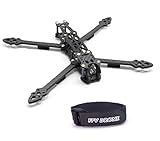
3. FPVDrone 225mm FPV Racing Drone Frame Carbon Fiber 5 inch — Best upgrade
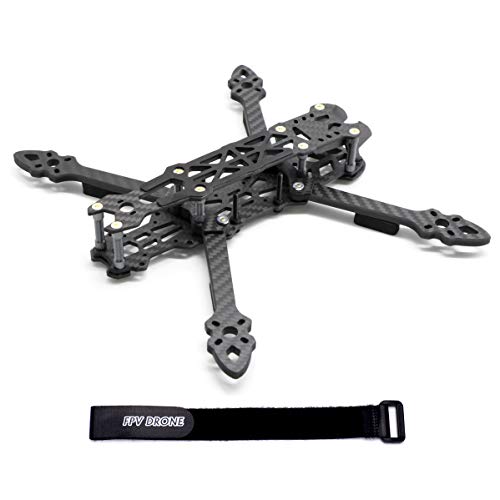
The 5-inch freestyle frame that fits both 30.5mm and 20mm flight controller stacks, at 3.6 oz bare.
Best for: a freestyle builder who already owns a stack and motors Skip it if: you have never soldered a flight controller
This is where the set shifts from buying to building. The frame measures 145mm x 172mm across the plates in a 225mm class, weighs 3.6 oz bare, and takes 5-inch props. It's the second-cheapest pick here, which makes sense: you're paying for carbon and hardware, nothing else.
The detail that matters most is mounting flexibility. FPVDrone says the frame has both 30.5 x 30.5mm and 20 x 20mm flight controller holes, and that the stack can sit centre or rear. That covers nearly every current stack format, so an existing parts bin is likely to fit. The listing also claims 25mm standoffs for a better centre-of-gravity relationship, full 3K carbon plate with CNC machining, and crash durability. A Lipo battery strap is included.
Among the three frames, this is the one with the most published detail on how electronics actually mount. That's the useful information when you're building.
The trade-off is obvious: it is an empty shell. No motors, no ESC, no camera, no receiver, no battery. Expect to spend more on the parts than on the frame, and expect to solder.
Pros:
- Accepts both 30.5mm and 20mm stack mounting
- 3.6 oz bare frame, lightest of the three frames
- Second-cheapest pick in this set
- Battery strap included in the box
- 25mm standoffs claimed for CG tuning
Cons:
- Ships with no electronics at all
- Requires soldering and FPV knowledge
- No camera, so no imaging spec to judge
- Slowest-selling of the three frames' peers in this category
4. FPVDrone 295mm FPV Racing Drone Frame 7inch Carbon Fiber — Best minimal setup
A 7-inch long-range frame with 5mm arms, sitting mid-range in price for this set.

Best for: long-range cruisers moving up to 7-inch props Skip it if: you fly in tight spaces or need a published weight figure
The 295mm class is where FPV builders go for distance rather than speed. Bigger props turn slower for the same thrust, which stretches flight time. FPVDrone describes this as a 7-inch freestyle frame designed for long range, built from full 3K carbon, with 5mm arm thickness for what the listing calls flexible and stable flight.
That 5mm arm figure is the number to focus on. Thicker arms flex less under load, and on a 7-inch build carrying a heavier battery pack, flex is what causes soft, vibrating footage. Compared with the 225mm frame above, this is the same brand's answer to a different flight profile: fewer tight turns, more straight-line cruising.
It sits mid-range in price for this set, between the two cheaper frames and the two costliest picks. The listing claims easy assembly suitable for beginners and experienced builders alike, and quotes a boxed size of 8.88 x 8.78 x 8.78 in.
The gap here is data. This is the only pick in the set with no published weight, which matters a great deal when you're calculating all-up weight for a build. You also get the same empty-shell reality as the 225mm frame.
Pros:
- 5mm arm thickness claimed for stiffness
- 7-inch props suit long-range cruising
- Full 3K carbon fiber construction claimed
- Mid-range price position for this set
Cons:
- No published bare frame weight, unlike every other pick
- No electronics, camera or battery included
- Too large for indoor or tight-space flying
- Only one seller lists it
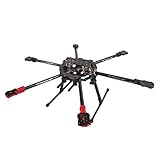
5. TAROT FY690S 6 Axle Full 3K Carbon Fiber Aircraft Frame — Best premium
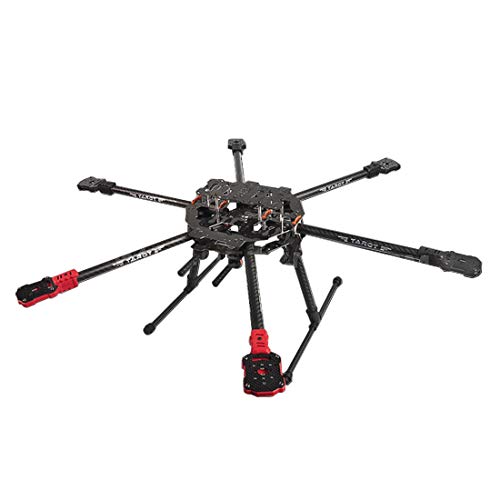
The only six-rotor airframe here, spanning 690mm and folding down for transport at 1.32 lb.
Best for: a multirotor builder carrying a real camera payload Skip it if: you want anything close to a pocketable drone
This is the outlier and the most expensive pick in the set. Six axles instead of four, 690mm across, 1.32 lb for the airframe alone, in orange and black. The boxed dimensions run 27.2 x 27.2 x 27.2 in, so nothing about this is casual.
Six rotors matter for one reason: payload. Lift spreads across more motors, which is why hexacopters get used to carry cameras and gimbals that a 5-inch quad cannot lift. TAROT claims Toray 3K woven CFRP plate and pure carbon fiber hollow tubes rather than glassy carbon, with full CNC machining, and states the chassis weighs only 600 grams. The arms fold, which is the practical concession to a 690mm span. The package is listed as one complete airframe set in the pure carbon pipe version.
Against the other frames, this is the one built for lifting rather than for tricks. It's also the only pick that names its carbon supplier.
The costs stack up. It's the priciest pick, the heaviest, and it needs six motors, six ESCs and a flight controller before it does anything. Six of everything is six times the parts bill.
Pros:
- Six-rotor layout for heavier camera payloads
- Toray 3K woven CFRP plate claimed
- Folding arms despite the 690mm span
- 600g chassis claim for its size class
- Pure carbon tubes rather than glassy carbon
Cons:
- Most expensive pick in this set
- Needs six motors and six ESCs, not four
- 1.32 lb before any electronics are added
- Slowest seller of the five picks
Ready-to-fly or bare airframe: which best full frame drone suits you?
The cutoff is a soldering iron. If you own one and know how to use it, the frames open up. If you don't, buy complete.
- You want footage this weekend. The RELIDOL PK01. Screen in the controller, 25 minutes claimed across two batteries.
- You want to hand a drone to a nine-year-old. The VVDZJX mini. Cheapest, lightest at 3.17 oz, one-tap launch claimed.
- You already have motors, ESCs and a stack in a drawer. The 225mm FPVDrone frame. Both stack hole patterns fit.
- You fly long, straight lines over open ground. The 295mm FPVDrone frame with 5mm arms.
- You need to lift a camera and gimbal. The TAROT FY690S. Six rotors, 690mm span.
Two flips worth naming. If your flying space is a back garden rather than a field, the 295mm and 690mm picks are the wrong size regardless of budget. And if repairability matters to you more than convenience, the ready-to-fly picks lose immediately, because neither publishes a spares path.
What a carbon fiber build actually involves
Buying a frame is buying maybe a fifth of a drone. Here's the honest sequence for the three carbon picks in this set.
- Choose motors sized to the frame. A 225mm 5-inch frame and a 690mm hexacopter want completely different motors. Four for the quads, six for the FY690S.
- Match ESCs to the motors and the battery voltage. This is where builds go wrong most often.
- Pick a flight controller that fits the mounting holes. The 225mm frame publishes 30.5 x 30.5mm and 20 x 20mm patterns, which is why I called it the flexible one.
- Solder everything. No shortcut exists. Budget an evening for a first build.
- Add a camera, video transmitter and receiver. None of the frames include imaging hardware, so no imaging spec exists to judge them on.
- Buy batteries and a charger. The 225mm frame includes a Lipo strap; that is the extent of the battery provision across all three frames.
Two of these frames publish a bare weight, 3.6 oz for the 225mm and 1.32 lb for the FY690S. Those figures are your starting point for all-up weight calculations, and all-up weight determines your flight time. The 295mm frame publishes none, which means you'll be weighing it yourself.
What the listings do not tell you
Reading these five listings side by side, the gaps are as informative as the specifications.
No sensor size, anywhere. Both camera picks say 1080p, which is a video resolution, not a sensor format. Neither states a sensor size in inches or millimetres. If you need a specific sensor, this set cannot confirm one for you.
No stated warranty on any of the five. Not one listing here publishes warranty terms. That's unusual enough to note, and it's the same across ready-to-fly and frame picks alike.
Battery figures are the manufacturer's claims. RELIDOL says 25 minutes across two batteries; VVDZJX says roughly 10 minutes per battery. Both are claims from the seller, and real flight time drops with wind, aggressive flying and cold weather. Treat quoted times as ceilings.
One seller per pick. Every product here is listed by a single seller, which limits your options if something goes wrong.
No control range published. None of the five states a maximum control or video distance, which is a figure long-range flyers usually want first.
Take the published, comparable figures seriously: weight, dimensions, frame size, arm thickness, mounting patterns. Treat the bracketed marketing copy as what it is.
The verdict
If you want to fly, the RELIDOL PK01 is the best full frame drone in this set. If you want to build, the TAROT FY690S is. The cutoff is whether you can solder six motor pairs without help.
The PK01 takes the top slot because it removes every barrier between purchase and first flight. Its remote carries its own screen, so no phone mount and no app pairing stand in the way. It publishes the most complete spec block of any pick: 4.06 oz, 2.56 x 11 x 10.2 in folded, model PK01. RELIDOL claims 25 minutes across two batteries and a 1080p lens on an 80° adjustable mount. It also sells faster than anything else here.
The FY690S wins for the other buyer, and its exact advantage is lift. Six rotors instead of four, spread across a 690mm span, with folding arms and a claimed 600g chassis in Toray 3K woven CFRP. Nothing else in this set can carry a gimbal and a real camera. That capability costs the most of any pick here and requires six motors, six ESCs and a flight controller before it leaves the ground.
Neither aircraft delivers a 35mm sensor, and no listing in this category claims one.
FAQ
Is the best full frame drone worth buying over a cheaper mini drone?
The best full frame drone is worth buying over a cheaper mini if you value flight time and controller convenience. The RELIDOL PK01 claims 25 minutes across two batteries against the VVDZJX mini's 20, and its remote has a built-in screen instead of a phone clamp. If you're buying a first drone for a child, the cheaper, lighter 3.17 oz mini makes more sense.
Does full frame mean a 35mm camera sensor on these drones?
Full frame does not mean a 35mm sensor on these drones. Here it refers to full 3K carbon fiber construction, meaning the plates and tubes are carbon throughout. Both camera picks quote 1080p video resolution, and neither publishes a sensor size in any unit. If sensor format is your requirement, shop aircraft that name the camera model on the listing.
RELIDOL PK01 or TAROT FY690S: which should I choose?
Choose the RELIDOL PK01 if you want a complete aircraft with a camera, two batteries and a screen-equipped controller at 4.06 oz. Choose the TAROT FY690S if you're building a six-rotor machine to carry a camera and gimbal across a 690mm span. The FY690S is an airframe only, at 1.32 lb, needing six motors and six ESCs.
What flight controller fits the 225mm FPVDrone frame?
The flight controller fits if it uses either standard mounting pattern. FPVDrone states the 225mm frame has both 30.5 x 30.5mm and 20 x 20mm hole spacings, with the stack mountable centre or rear. That covers most current stacks. The listing also claims 25mm standoffs for centre-of-gravity tuning, and a Lipo battery strap is included in the box.
What is the biggest mistake when buying a full frame drone?
The biggest mistake when buying a full frame drone is not noticing that three of these five products are bare frames. The carbon picks arrive with no motors, no ESCs, no battery, no camera and no receiver. Read the package contents line before ordering. The TAROT listing, for example, states one airframe set and nothing more.
Start with the question of what arrives in the box, because that single answer sorts this entire category. If your answer is "a drone I can fly," order the RELIDOL PK01 and charge both batteries while you read the pairing steps. The screen in the controller is the quiet reason it wins: it removes the one step that most often turns a first flight into a frustrating afternoon of app troubleshooting. If your answer is "parts I'll assemble," measure your flying space first, then match a frame size to it before you buy a single motor.