Best Mini Drone for Street Photography in Tight Spaces
Six sub-249 g quadcopters compared on gimbal type, sensor size, flight time and folded bulk, with a named winner and the conditions that flip the pick.

By Travis WaltersUpdated 17 min read
On this page
- Best mini drone for street photography at a glance
- How I screened these six mini drones for street photography
- Why the sensor spec matters more than the megapixel count
- 1. DJI Mini 4K — Best overall
- 2. DJI Mini 5 Pro Fly More Combo Plus with DJI RC 2 — Best premium
- 3. Potensic ATOM SE GPS Drone with 4K EIS Camera — Best minimal setup
- 4. Bwine F7MINI 8K Photo 5.5" 1080P RC Screen Drone — Best for pros
- 5. Specta Mini Drone with Camera 4K for Adults — Best upgrade
- 6. RELIDOL Drone with Camera, Screen on Controller — Best budget pick
- Can a drone legally shoot street photography at all?
- Which mini drone for street photography fits in a jacket pocket?
- What more money actually buys in this set
- The verdict
- FAQ
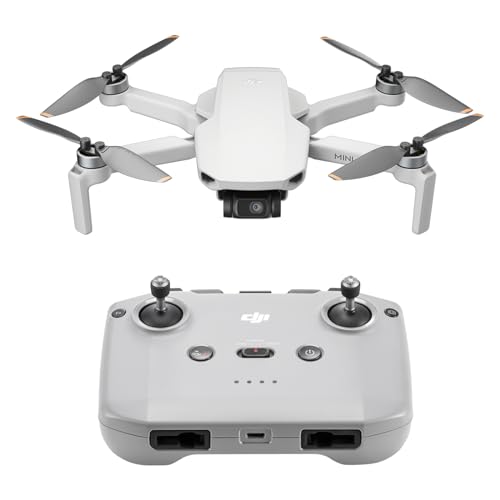
The best mini drone for street photography is the DJI Mini 4K, because it pairs a 4K UHD camera and a 3-axis gimbal with a 0.53 lb body that stays under the 249 g line. If you want a 1-inch sensor and true vertical framing for tall city frames, the DJI Mini 5 Pro Fly More Combo Plus is the better buy, and it costs the most of the six here.
This is not gear for everyone. If your work is candid faces at close range on a busy sidewalk, a drone is the wrong tool and a compact camera is the right one. Drones shoot elevated geometry: crosswalks, rooftops, alley lines, the shape of a block at golden hour. If that's not the picture you want, spend the money on a fast prime instead.
Best mini drone for street photography at a glance
| Pick | Camera & gimbal | Flight time claim | Price |
|---|---|---|---|
Best overall DJI Mini 4K |
4K UHD 3-axis gimbal |
31 min per battery | Check Price |
Best premium DJI Mini 5 Pro Fly More Combo Plus |
1-inch CMOS, 4K/60fps HDR 225° gimbal rotation |
Extended, count not listed | Check Price |
Best minimal setup Potensic ATOM SE |
4K/30fps, 1/3" Sony CMOS electronic stabilisation |
62 min, 2 batteries | Check Price |
Best for pros Bwine F7MINI |
8K photo claim, 4K UHD 3-axis brushless gimbal |
64 min, 2 batteries | Check Price |
Best upgrade Specta Mini Drone 4K |
4K/30fps 3-axis gimbal |
31 min claim | Check Price |
Best budget pick RELIDOL PK01 |
1080p HD, 80° tilt lens no gimbal listed |
25 min, 2 batteries | Check Price |




How I screened these six mini drones for street photography
I started from the published listing data and lined up the specifications side by side. Nothing here is a field report. Everything here is what the manufacturers state, compared across a single set.
Three screens did the cutting:
- Sub-249 g flying weight. Five of the six listings state it outright. That threshold is the single reason a mini drone is usable in a city at all, because it removes the FAA registration and Remote ID step for recreational flying in the United States.
- A stabilised camera. Four of the six list a 3-axis gimbal. One lists electronic stabilisation. One lists neither.
- A stated flight time. Five listings publish a figure. Short battery life kills street work faster than a soft lens, because the light you want lasts twenty minutes and you spend half of it repositioning.
Weight figures deserve one warning. Amazon's weight field is packed shipping weight, not flying weight, and the two diverge badly. The Specta listing shows 2.2 lb in that field while its own feature text claims under 249 g in the air. Read the field as "how big is the box", not "what does it weigh in the sky".
I also cut nothing for brand reputation. Two DJI models, one Potensic, one Bwine, one Specta and one RELIDOL made it through on published specifications alone.
Why the sensor spec matters more than the megapixel count
Most guides to the best mini drone for street photography rank on resolution. That is the wrong axis. City shooting happens at dusk, in shadowed streets, under mixed light from shopfronts and sodium lamps, and resolution does nothing for you there.
Sensor size is what decides it. The DJI Mini 5 Pro is the only pick in this set with a 1-inch CMOS. The Potensic ATOM SE states a 1/3-inch Sony CMOS. That is a large gap in light-gathering area, and it shows up exactly where street photography lives: after sunset.
Then there is stabilisation. A 3-axis mechanical gimbal physically counters the airframe's movement. Electronic stabilisation crops and warps the frame in software. For stills, the mechanical version is the one you want, because it holds the horizon while the drone fights a gust between buildings.
The megapixel headline is the least useful number on any of these listings. Bwine advertises an 8K photo mode and 48MP resolution. That says nothing about the size of the pixels collecting the light.
1. DJI Mini 4K — Best overall
The DJI Mini 4K hits the useful middle: a 3-axis gimbal, 4K UHD stills and video, and a 0.53 lb body that clears the paperwork threshold.
Best for: shooters who want a 3-axis gimbal and no FAA paperwork Skip it if: you need obstacle sensing for low-light flying
Within this set, the Mini 4K is the pick that gets the fundamentals right without asking for the premium tier. Folded dimensions of 2.16 x 7.87 x 6.29 in make it the flattest body of the six on its shortest axis, which matters when you're sliding it into a camera bag next to a body and two lenses.
DJI states 38 kph Level 5 wind resistance and brushless motors with takeoff up to 4,000 metres. Wind is the practical enemy of urban aerial work, because gaps between buildings funnel it. The listing also names 4K Ultra HD with the 3-axis gimbal for sunrise, sunset and night scenes, which is a claim rather than a measurement, but the mechanical gimbal behind it is real hardware.
Battery configuration is your choice at purchase: a 1-battery set at 31 minutes, a 2-battery set at 62 minutes, or a 3-battery set at 93 minutes. It is also the only pick here with a manufacturer warranty listed, and it sells faster than every other model in this group.
The trade-off is sensing. The Mini 5 Pro lists omnidirectional obstacle detection and this one lists none, so night flying near structures is entirely on your judgment.
Pros:
- 3-axis gimbal with 4K UHD stills and video
- 0.53 lb, the lightest stated flying weight here
- Flattest folded profile of the six
- Level 5 wind resistance claim, 38 kph
- Only pick in this set with a listed warranty
Cons:
- No obstacle sensing of any kind listed
- Smaller sensor than the Mini 5 Pro
- The DJI Fly app is not available on Google Play per the listing
- Extra batteries mean choosing the pricier bundle
2. DJI Mini 5 Pro Fly More Combo Plus with DJI RC 2 — Best premium
The 1-inch CMOS and 225° gimbal rotation make this the only pick in the set built for vertical city frames and after-dark flying.

Best for: photographers who want a 1-inch sensor and vertical framing Skip it if: you want the smallest possible carry kit
Two specifications set this apart from everything else here. The 1-inch CMOS is the largest sensor in the group, and it shoots 4K/60fps HDR video according to DJI. The 225° gimbal roll with true vertical filming is the other, and for street work it's the more interesting of the two. Tall frames are the natural shape of a city: a stairwell, a fire escape, a street canyon between towers.
DJI lists forward-facing LiDAR plus vision sensors for omnidirectional obstacle detection, described as Nightscape sensing and aimed specifically at night flights and return-to-home. No other pick in this set publishes anything comparable. It also lists 42 GB of internal storage, so a forgotten card doesn't end the session, and ActiveTrack 360° with customisable tracking modes.
The combo ships with the DJI RC 2 controller, which is why the boxed dimensions read 3.58 x 12 x 15 in. The aircraft itself is 0.55 lb. Released in 2025.
Two trade-offs. It's the most expensive pick here and only one seller lists it. And unlike the Mini 4K, no warranty appears in its specifications.
Pros:
- 1-inch CMOS, the largest sensor in this set
- True vertical filming plus 225° gimbal roll
- Omnidirectional obstacle sensing including LiDAR
- 42 GB internal storage claim
- Dedicated RC 2 controller included
Cons:
- Most expensive pick in this group
- No warranty listed in the specifications
- Only one seller stocks it
- Largest packed dimensions of the six
3. Potensic ATOM SE GPS Drone with 4K EIS Camera — Best minimal setup
Two 2500mAh batteries for a stated 62 minutes total means you can work a whole evening's light without a charger in the bag.

Best for: day-trip shooters who hate charging between locations Skip it if: you want a 3-axis mechanical gimbal
The ATOM SE is the pack-light option. Folded dimensions of 2.28 x 5.63 x 3.46 in are the smallest in this set by volume, and Potensic says it fits a jacket pocket. At 0.55 lb it clears the 249 g line, so no FAA or Remote ID registration for recreational use.
Two intelligent 2500mAh batteries are in the box, each rated at 31 minutes for 62 total. That configuration is what earns the award. Street light changes fast, and two batteries means you shoot the blue hour and the lit-window hour without going home in between.
The camera is a 1/3-inch Sony CMOS shooting 12MP stills and 4K/30fps video, per the listing, with electronic image stabilisation rather than a mechanical gimbal. PixSync 2.0 transmission is stated at 4 km, and Potensic claims Level 5 wind resistance plus a max speed of 16 m/s. SurgeFly control offers Beginner Mode and three flight modes: Video, Normal and Sport.
Here's the honest cost. EIS crops the frame and softens edges, so for stills this sits below the four gimballed picks. It's also the slowest-selling of the two mid-priced options here.
Pros:
- Two 2500mAh batteries, 62 minutes stated total
- Smallest folded volume in this set
- 1/3-inch Sony CMOS with 12MP stills
- 4 km PixSync 2.0 transmission claim
- Beginner Mode plus three flight modes
Cons:
- Electronic stabilisation, not a 3-axis gimbal
- Smallest sensor among the 4K picks
- No warranty listed
- Video capped at 30fps per the listing
4. Bwine F7MINI 8K Photo 5.5" 1080P RC Screen Drone — Best for pros
A 5.5-inch 1080p screen built into the controller means no phone in the loop, which is the fastest way to work a busy street corner.

Best for: shooters who want a built-in controller screen and long range Skip it if: you dislike premium pricing for a lesser-known brand
Mounting a phone, launching an app and waiting for a link is dead time, and dead time on a street corner is a lost frame. Bwine's answer is a 5.5-inch 1080p display in the remote itself. Two picks in this set use a screen controller, and this one has the larger panel.
The camera specification is aggressive: 8K photo at 48MP with 4K UHD video, on a 3-axis brushless gimbal, per Bwine. Read the 8K figure as an upscaled output rather than a native sensor readout, since no sensor size appears in the listing. The gimbal is the part that matters, and it's mechanical.
Range is stated at 20,000 ft, roughly 6 km. Two batteries at 32 minutes each give a claimed 64 minutes, the highest total in this group. Weight is 0.55 lb and folded dimensions are 2.28 x 5.55 x 3.42 in, near-identical to the ATOM SE. Bwine confirms it sits under 249 g with GPS on board.
Against the set, it's the second-most expensive pick and publishes no sensor size, no warranty and no wind rating. That's a lot of blanks at this price position.
Pros:
- 5.5-inch 1080p screen in the controller, no phone needed
- 3-axis brushless gimbal
- 64 minutes stated across two batteries
- 20,000 ft transmission claim
- Compact folded body at 2.28 x 5.55 x 3.42 in
Cons:
- No sensor size published anywhere in the listing
- 8K photo figure is almost certainly upscaled
- Second-highest price position with fewer specs than the Mini 5 Pro
- No warranty and no wind resistance figure listed
5. Specta Mini Drone with Camera 4K for Adults — Best upgrade
A 3-axis gimbal and 4K/30fps at the second-lowest price here is the cheapest route to genuinely stabilised aerial stills.

Best for: buyers stepping up from a toy quadcopter on a tight budget Skip it if: packed weight and bulk matter to you
Every other 3-axis gimbal in this set sits in the mid or premium tier. This one doesn't, and that's the whole argument for it. Specta lists a 3-axis gimbal with 4K Ultra HD footage, plus one-button takeoff and landing and GPS Return-to-Home.
Transmission is claimed at 32,800 ft, about 10 km, the longest stated figure in this group. Flight time is listed at 31 minutes on a single battery. Specta states the aircraft is below 249 g, so no FAA or Remote ID registration for recreational flying.
Now the awkward part. The listing's weight field reads 2.2 lb and its dimensions are 2.2 x 9.6 x 11.4 in, both of which describe the shipped package rather than the flying aircraft. Compare that against the Mini 4K's 0.53 lb and you can see the mismatch. Take the sub-249 g claim from the feature text as the flying figure and the 2.2 lb as the box.
Beyond the gimbal and the range number, the listing is thin. No sensor size, no model number, no colour beyond gray, no warranty. This is the slowest seller of the six by a wide margin, and it's the pick with the least published detail behind its headline claims.
Pros:
- 3-axis gimbal at the second-lowest price position
- 32,800 ft transmission, longest stated range here
- 31-minute flight time claim
- GPS Return-to-Home and one-button takeoff
Cons:
- Weight and dimension fields describe the box, not the aircraft
- No sensor size, model number or warranty listed
- Slowest seller of the six
- Single battery, against 62 and 64 minutes elsewhere
6. RELIDOL Drone with Camera, Screen on Controller — Best budget pick
The cheapest pick here, and the honest way to learn framing and airspace habits before committing to a gimballed camera.
Best for: first-time flyers learning framing before spending more Skip it if: you need 4K stills or a stabilising gimbal
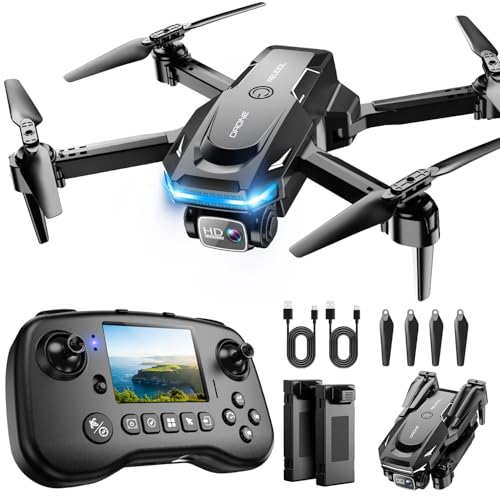
At 4.06 oz, the PK01 is by far the lightest airframe in this set, and it's the cheapest of the six. It also sells faster than four of the other five picks, which tells you where most buyers start.
The remote has a built-in screen for live HD footage and flight stats, so no phone pairing. Two control modes are listed: remote and app. RELIDOL includes two enhanced batteries for a stated 25 minutes total, and lists one-click 360° flips, 3D flips, waypoint flight and gravity control.
The camera is where it separates from everything above. It's a 1080p HD lens with an 80° adjustable tilt, and no gimbal appears anywhere in the specifications. For street photography that means two hard limits: half the vertical resolution of the 4K picks, and a frame that moves whenever the airframe does. Print a 1080p aerial frame beyond a small size and it falls apart.
Buy this to learn where you can legally fly, how a drone behaves between buildings, and what an elevated frame looks like. Then buy the Mini 4K. Treated as a first step rather than a final camera, it's a reasonable purchase. Treated as a photography tool, it's outclassed by every other pick here.
Pros:
- Cheapest pick in this set
- 4.06 oz, the lightest airframe here
- Built-in controller screen, no phone required
- Two batteries for a stated 25 minutes
Cons:
- 1080p only, against 4K on five other picks
- No gimbal listed, just an 80° tilt lens
- Shortest stated flight time of the six
- No stated sub-249 g figure or GPS return-to-home
Can a drone legally shoot street photography at all?
This is the question that decides whether any of these belongs in your bag, and no specification sheet answers it.
Sub-249 g removes the FAA registration and Remote ID step for recreational flying in the United States. Five of these six listings state that weight explicitly. What it does not remove:
- Controlled airspace. Most dense urban cores sit under airport approach paths. You need authorisation, and in many cases you will not get it.
- Local ordinances. Cities, counties and parks departments set their own launch and landing rules independently of federal airspace rules.
- People below. Flying over uninvolved crowds is restricted, and a sidewalk at rush hour is exactly that.
- Privacy. State law governs what you can record of private property from the air, and it varies.
So treat the modifier honestly. None of these six is certified or approved for street photography, because that's not a category any manufacturer can sell into. What they offer is a stabilised camera on a light airframe. Whether you can put it up over a given intersection is on you to check, every single time, before the props spin.
Practically, most usable urban aerial work happens at the edges: riverfronts, industrial blocks, bridges, empty early-morning streets, rooftop-legal spots with permission.
Which mini drone for street photography fits in a jacket pocket?
Folded volume matters more than weight when you're carrying a camera too. Here's how the set stacks up on stated folded dimensions:
- Potensic ATOM SE — 2.28 x 5.63 x 3.46 in, smallest by volume
- Bwine F7MINI — 2.28 x 5.55 x 3.42 in, essentially tied
- DJI Mini 4K — 2.16 x 7.87 x 6.29 in, thinnest but longer
- RELIDOL PK01 — 2.56 x 11 x 10.2 in
- Specta — 2.2 x 9.6 x 11.4 in, packed figure
- DJI Mini 5 Pro combo — 3.58 x 12 x 15 in, boxed with the RC 2
Two caveats. The Specta and RELIDOL figures look like packaged measurements, so their real folded size is smaller. And the Mini 5 Pro figure covers a full combo box including a controller, not the aircraft folded.
If a jacket pocket is your only constraint, the ATOM SE and the F7MINI are the two picks that genuinely disappear. The Mini 4K needs a bag, but it's the flattest of the group at 2.16 in, which slides into a laptop sleeve better than a cube does.
What more money actually buys in this set
The gap between tiers here is unusually clean, which makes the decision easier than in most categories.
Entry tier. You get either resolution or stabilisation, rarely both. The RELIDOL gives you a controller screen and 1080p. The Specta gives you a 3-axis gimbal and 4K but almost no published specifications behind it.
Mid tier. This is where the fundamentals arrive. The Mini 4K brings a 3-axis gimbal, 4K UHD, a Level 5 wind rating and a warranty. The ATOM SE brings 62 minutes of stated flight time and a named Sony sensor. Both weigh 0.53 to 0.55 lb.
Premium tier. Money buys sensing and sensor area. The Mini 5 Pro's 1-inch CMOS, LiDAR-assisted omnidirectional detection and 225° gimbal roll are capabilities absent everywhere else. The F7MINI's premium position buys a bigger controller screen and 64 stated minutes, but not a published sensor size.
That last point is the one to weigh. Two picks share the top of the price range, and only one of them tells you what's behind the lens.
The verdict
Entry tier. Start with the RELIDOL PK01 only if you want to learn to fly before you spend properly. It's the cheapest here and the lightest airframe at 4.06 oz, but 1080p with no gimbal is not a photography camera. The Specta is the better entry buy if you want 4K and a 3-axis gimbal now, accepting that its listing publishes almost nothing else.
Middle tier. The DJI Mini 4K is the pick I'd default to. A 3-axis gimbal, 4K UHD, 0.53 lb, a 38 kph wind resistance claim, a warranty, and battery bundles up to a stated 93 minutes. That combination doesn't exist elsewhere in this set at this price position. The Potensic ATOM SE wins on one specific axis: 62 minutes across two included batteries, and the smallest folded body here. Take it if a full evening without a charger matters more to you than a mechanical gimbal.
Premium tier. The DJI Mini 5 Pro Fly More Combo Plus is the only pick with a 1-inch CMOS, and the only one with omnidirectional obstacle sensing for flying after dark. Its 225° gimbal roll and true vertical filming are aimed squarely at tall city frames. The Bwine F7MINI's advantage over it is narrower: a 5.5-inch 1080p controller screen and a stated 64 minutes. That's a workflow win, not an image-quality win.
FAQ
Is a mini drone worth it for street photography?
A mini drone is worth it for street photography only if elevated geometry is the picture you want. Crosswalk patterns, rooftop lines, bridge spans and empty morning blocks all work well from 100 feet. Candid faces at eye level do not. Buy one as a second perspective alongside a handheld camera, never as a replacement for it.
Which offers better value, the DJI Mini 4K or the Potensic ATOM SE?
Between the DJI Mini 4K and the Potensic ATOM SE, the Mini 4K offers better value for stills because its 3-axis mechanical gimbal beats electronic stabilisation and it's the only pick here with a listed warranty. The ATOM SE wins if flight time decides it: two 2500mAh batteries for a stated 62 minutes, against 31 minutes on the Mini 4K's single-battery set.
Do I need to register a sub-249 g drone with the FAA?
You do not need to register a sub-249 g drone for recreational flying in the United States, and five of these six listings state that weight. Registration and Remote ID are separate from airspace rules, though. Controlled airspace near airports, local launch ordinances and restrictions on flying over crowds all still apply regardless of weight.
What sensor size should I look for in a mini drone for street photography?
For sensor size in a mini drone for street photography, larger is better because city shooting happens in low and mixed light. The DJI Mini 5 Pro's 1-inch CMOS is the largest here. The Potensic ATOM SE lists a 1/3-inch Sony CMOS. Two picks publish no sensor size at all, which makes their low-light performance impossible to judge from the listing.
Is 4K resolution enough for aerial stills?
4K resolution is enough for aerial stills at web sizes and moderate prints, and five of these six picks offer it. Resolution isn't the limiting factor anyway. Stabilisation and sensor area are. A gimballed 4K frame beats an unstabilised higher-resolution one every time, which is why the 1080p RELIDOL sits last in this ranking.
Pick your tier and buy once. The DJI Mini 4K is the sensible default because it solves the two problems that actually ruin aerial street frames, a shaky horizon and a 249 g paperwork trigger, without pushing you into the premium range. Before it arrives, spend an evening with an airspace map and mark three legal launch spots near you: a riverfront, an industrial block, a bridge approach. That research does more for your first shoot than any specification on this page, because the best camera in the set is worthless over an intersection you can't legally fly.