Best Obstacle Avoidance Drones for Filming Outdoors

Seven obstacle avoidance drones compared on published sensor coverage, weight, screen setup and battery count, with a named winner and the conditions that flip the pick to something cheaper.

By Travis WaltersUpdated 19 min read
On this page
- Best with obstacle avoidance drone for content creators at a glance
- How I screened these seven listings
- Why sensor coverage decides this more than camera specs
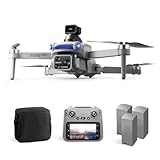
- 1. SKYROVER X1 Drone with Camera Combo for Adults — Best overall
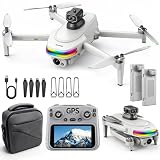
- 2. SJsharp Drone with Camera for Adults LCD Screen FPV Live — Best minimal setup
- 3. Giffke XT606 GPS Drone with Camera for Adults 4K EIS — Best upgrade
- 4. SEKOsamrt Drone with Camera for Adults LCD Screen on — Best budget pick
- 5. RAIGNV S119 GPS 4K Drone with Camera and 5G Screen Remote — Most versatile
- 6. HZMOFTJ Drones With Camera For Adults 4k 50 Mins Flight 2 — Best for pros
- 7. Bingchat Tablet Remote Professional Drones with Camera for — Best premium
- Does obstacle avoidance actually help a content creator?
- Screen on the controller or your phone?
- What the 249g line means for your footage
- What more money buys across these seven
- The verdict
- FAQ
The best with obstacle avoidance drone for content creators is the SKYROVER X1, because it's the only pick here whose listing claims 360-degree sensing while staying at 0.55 lb with three batteries in the box. If you'd rather not spend at the top of this set, the SJsharp TT19LCD at 6.35 oz gets you a 2.8-inch controller screen and a claimed 270-degree sensing system for far less. This guide isn't for everyone. If your work needs a licensed cinema rig with interchangeable lenses and log profiles, none of these seven listings will satisfy you, and a mirrorless camera on a gimbal is the better spend.
Best with obstacle avoidance drone for content creators at a glance
| Pick | Sensing coverage | Weight | Price |
|---|---|---|---|
Best overall SKYROVER X1 Drone with Camera Combo for Adults |
360° claim | 0.55 lb | Check Price |
Best minimal setup SJsharp Drone with Camera for Adults LCD Screen FPV Live |
270° claim | 6.35 oz | Check Price |
| 4-way claim | 7.87 oz | Check Price | |
Best budget pick SEKOsamrt Drone with Camera for Adults LCD Screen on |
270° claim | 6.35 oz | Check Price |
| Not published | 1.81 x 4.73 in body | Check Price | |
| Not published | 6.81 oz | Check Price | |
| 360° laser claim | 1.3 lb | Check Price |



How I screened these seven listings
I lined up the published specifications for all seven side by side and sorted them on the one thing the keyword asks for: does the listing state a sensing coverage figure, and how wide is it?
That single question split the set immediately. Four listings publish a number. Three do not, and two of those three sit in the top half of the price positions here. That's the sort of gap you only see when you stop reading headline copy and start reading the specification block.
Here's the order I worked in:
- Sensing coverage first. A stated 360-degree or 270-degree claim beat a vague mention.
- Weight second, because the 249g line changes what you legally do with the footage in the US.
- Controller type third. A built-in screen is a different workflow to a phone clamp.
- Battery count fourth, from the count figure in each listing.
- Price position last, only to break ties.
What I cut: nothing in this set was disqualified outright, because all seven mention obstacle sensing somewhere in their copy. But three of them never attach a coverage figure to that mention, and that pushed them below the four that do.
One honest caveat before you read on. Amazon's results for a creator-focused search return general consumer drones, not gear built around a creator workflow. The picks below are judged on what their listings publish about sensing, weight and camera capability. Whether that suits your specific shooting style is a call you make, not one the listing data can make for you.
Why sensor coverage decides this more than camera specs
Most drone roundups lead with resolution. Six of these seven listings claim 4K somewhere, so resolution tells you almost nothing about which one to buy.
Sensor coverage is the figure that actually separates them. A drone with forward-only sensing will happily reverse into a tree while tracking you, because nothing behind it is watching. That's the shot you lose, and often the drone too.
The published coverage figures across this set:
- SKYROVER X1: 360-degree obstacle sensing claim, plus Smart Return to Home
- Bingchat: 360-degree laser obstacle avoidance claim
- SJsharp TT19LCD: 270-degree sensing claim, front and both sides
- SEKOsamrt TT19LCD: 270-degree sensing claim, front and both sides
- Giffke XT606: four-way obstacle avoidance claim
- RAIGNV S119 and HZMOFTJ: no coverage figure published
The gap between 270 and 360 degrees is the rear. If you shoot reverse pull-aways, orbit shots or any tracking move where the drone flies backwards, that rear quadrant is exactly where you need eyes. If you shoot static hovers and slow forward pushes, 270 degrees covers your real risk.
All of these are manufacturer claims, not standardised measurements. Treat them as a description of what the maker built, not a guarantee of what it catches.
1. SKYROVER X1 Drone with Camera Combo for Adults — Best overall
The widest published sensing coverage in this set, in the lightest body, with three batteries included.
Best for: creators who want the widest sensor coverage and three batteries in one box Skip it if: you only need occasional footage and can't justify the top price position
Three things put this ahead of the rest of the set. First, SKYROVER states 360-degree obstacle sensing rather than a partial arc, which matters the moment you fly a reverse move. Second, at 0.55 lb it's the lightest of the three picks that publish a full-circle or near-full-circle claim. Third, the count figure is 3, so you get a battery rotation rather than one pack and a wait.
The camera claims are the strongest here on paper. SKYROVER lists 4K at 60fps HDR video and 48MP stills from a 1/1.32-inch CMOS sensor, plus vertical shooting, which is the one specification in this whole set aimed squarely at short-form video. The listing also claims 9.32-mile SkyBridge transmission with a 1080p/60fps live view, and 96 minutes of total flight across the three packs.
Folded, it measures 2.6 x 5.9 x 3.66 in, small enough to sit in a camera bag pocket rather than needing its own case.
The trade-off is money and supply. It sits at the second-highest price position of the seven, and only one seller lists it. You're also paying for tracking modes that take practice to use well.
Pros:
- Widest published sensing claim in this set
- Lightest body among the 360-degree claims
- Three batteries, 96-minute total claim
- Vertical shooting mode for short-form
- Sells faster than five of the six others here
Cons:
- Second-highest price position of the seven
- Only one seller lists it
- No published warranty term
- Camera figures are manufacturer claims, not measured
2. SJsharp Drone with Camera for Adults LCD Screen FPV Live — Best minimal setup
The fastest path from bag to first shot, with sensing coverage published and no phone in the loop.

Best for: creators who want to fly straight out of the bag with no phone pairing Skip it if: you need 4K delivery files
This is the pick for anyone who's lost a shot to a phone that wouldn't pair. The 2.8-inch HD screen sits in the controller, so your phone stays in your pocket and your battery stays charged for the day's other work.
SJsharp publishes a 270-degree sensing claim covering the front and both sides, which is the second-widest coverage figure in this set behind the two 360-degree claims. Brushless motors and a 90-degree electrically adjustable lens are both listed, and the arms fold. At 6.35 oz it ties for the lightest weight of all seven picks.
Then there's the honesty in the copy, which I'll credit: the listing states outright that this is not a 4K drone. It's an FPV HD camera. That's a real constraint for a creator delivering client work, and it's the reason this sits second rather than first.
Against the SKYROVER, you're giving up resolution, the rear sensing quadrant and two spare batteries. What you get back is the second-cheapest price position here and the simplest possible pre-flight routine. For B-roll, location scouting and social clips, that swap is often the right one.
Pros:
- 2.8-inch screen built into the controller
- 270-degree sensing claim, front and sides
- Ties for lightest at 6.35 oz
- Second-cheapest of the seven
- Brushless motors and foldable arms listed
Cons:
- Not a 4K camera, stated in the listing
- Single battery, count of 1
- No rear sensing coverage
- Only one seller lists it
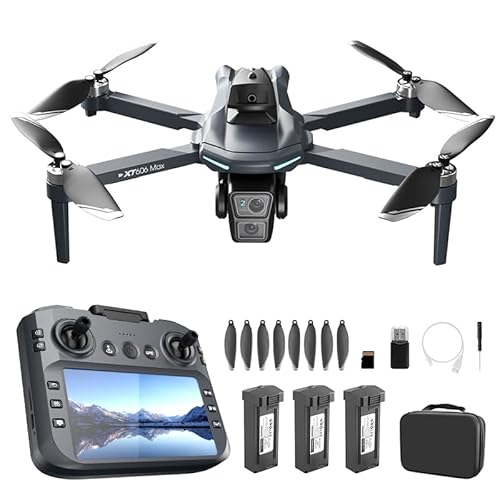
3. Giffke XT606 GPS Drone with Camera for Adults 4K EIS — Best upgrade
GPS positioning, a 4.3-inch screen and a stated 4K camera, all in an entry price position.
Best for: someone stepping up from a toy drone who wants GPS and a screen Skip it if: you want 360-degree sensing rather than four directions
The XT606 is the value inflection point in this set. It's the third-cheapest of seven, yet it publishes GPS positioning, four-way obstacle avoidance, a 4K camera with EIS, and a 4.3-inch LCD display on the controller. That 4.3-inch screen is larger than the 2.8-inch displays on both TT19LCD picks.
Giffke lists accurate GPS flight up to 1640 ft, brushless motors rated for four-level wind conditions, a 120-degree wide-angle lens and a 90-degree adjustable pitch. The colour option supplied is a three-battery configuration, so you're not flying on one pack. At 7.87 oz and 5.98 x 3.46 x 3.38 in folded, the listing states it stays under 249g and therefore needs no FAA or Remote ID registration in the US.
Four-way sensing is the limitation. Four directions is coverage at four points, not a continuous arc, and it's a step below the 270-degree claims on the two TT19LCD units. For forward pushes and hovers you'll rarely notice. For fast lateral moves, you might.
Against the SKYROVER, you lose the 60fps frame rate, the 48MP stills and the full-circle sensing. You keep the screen, the GPS and most of the money.
Pros:
- 4.3-inch built-in screen, largest at this price position
- GPS with 1640 ft stated range
- 4K camera with EIS listed
- Three-battery configuration supplied
- Under 249g per the listing
Cons:
- Four-way sensing, not a continuous arc
- Only one seller lists it
- Colour listed as a battery configuration, not a finish
- Slower seller than four others here
4. SEKOsamrt Drone with Camera for Adults LCD Screen on — Best budget pick
The cheapest of the seven, and it still publishes a 270-degree sensing figure.

Best for: first-time flyers testing whether aerial footage fits their work Skip it if: you need long-range transmission figures published
If you're not yet sure aerial footage belongs in your workflow, buy the cheapest thing that won't fly into a wall. This is that. It's the cheapest of the seven and it still publishes a 270-degree sensing claim covering the front and both sides.
The specification list is close to the SJsharp: a 2.8-inch HD display on the controller, an FPV HD camera with a 90-degree remotely adjustable lens, brushless motors, foldable arms, a modular battery and support for a 32GB SD card. Weight is 6.35 oz, tying for lightest here. Folded dimensions are 2.1 x 8 x 6.1 in.
What the listing never publishes is a transmission range figure, and that's the gap you'll feel first. Without a stated range, you're flying by feel and staying close, which limits the wide establishing shots that make drone footage worth the effort in the first place.
Two sellers stock it, which is one more than four of the picks here. It also sells faster than four others in this set, so it isn't an obscure listing.
Pros:
- Cheapest of all seven picks
- 270-degree sensing claim published
- 2.8-inch controller screen
- Ties for lightest at 6.35 oz
- Two sellers stock it
Cons:
- No transmission range figure published
- No 4K claim in the listing
- Count field left blank, so battery quantity unclear
- No rear sensing coverage
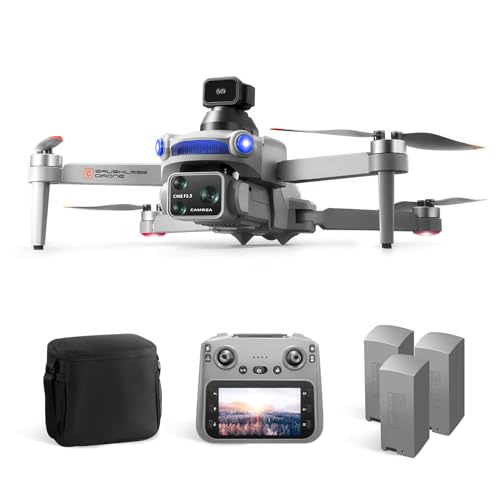
5. RAIGNV S119 GPS 4K Drone with Camera and 5G Screen Remote — Most versatile
The longest stated control distance in this set, paired with a 5G screen remote.
Best for: creators who shoot at distance and want a spare battery rotation Skip it if: obstacle sensing is your main reason for buying
The S119 earns its place on range. RAIGNV states up to 2000m control distance with real-time FPV through a 5G Wi-Fi screen remote, which is the widest operating envelope published by any pick here apart from the SKYROVER. For coastline sweeps and long valley pulls, that figure is the one that matters.
The rest of the listing is solid. A 4K front camera with 12MP stills, a 120-degree wide-angle lens and a 0 to 90-degree adjustable angle. Three modular 7.4V 3800mAh batteries at roughly 25 minutes each, for a stated 75-minute total. GPS with one-key return, low-battery return and lost-signal return. Brushless motors. It sits at the fourth price position of seven, so roughly mid-range for this set.
Here's the problem for this specific search: the listing never publishes an obstacle sensing coverage figure. GPS return-to-home is a different safety system entirely. It brings the drone home; it doesn't stop it hitting a branch on the way.
Two sellers stock it. The published weight figure of 58 lb is clearly a listing error rather than a real mass, so use the 1.81 x 4.73 x 4.73 in body dimensions to judge its size instead.
Pros:
- 2000m stated control distance
- Three 3800mAh batteries, 75-minute total claim
- Three GPS return modes listed
- 0 to 90-degree adjustable camera angle
- Two sellers stock it
Cons:
- No obstacle sensing coverage figure published
- Published weight figure is unusable
- Slowest-selling of the entry and mid picks here
- 12MP stills, below the SKYROVER's claim
6. HZMOFTJ Drones With Camera For Adults 4k 50 Mins Flight 2 — Best for pros
The largest controller screen in this set, at 5.5 inches, plus an airdrop mount.
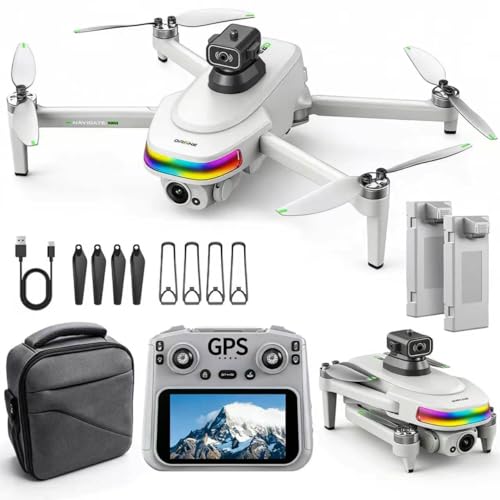
Best for: event shooters who want the largest controller screen here Skip it if: you need published obstacle sensing coverage
The 5.5-inch display on this controller is nearly twice the diagonal of the 2.8-inch screens on the two TT19LCD picks. If you frame carefully and you're tired of squinting, that difference is real, and it's the single strongest reason to pick this one.
HZMOFTJ lists 4K dual cameras with a 130-degree wide-angle lens and a 90-degree adjustable tilt, two 3800mAh batteries for a stated 50-minute total, and a smart airdrop feature for mounting small items. Event shooters use that last one for reveals at weddings and parties. Published weight is 6.81 oz, and the listing claims under 200 grams, comfortably inside the 249g line. Folded dimensions are 4.5 x 11.6 x 9.5 in, the bulkiest footprint of the seven.
Two problems keep it near the bottom of this ranking. The listing publishes no obstacle sensing coverage figure at all, which is a hard miss for this particular search. And it sits at the third-highest price position of seven while offering less published sensing detail than every entry-priced pick above it.
Two sellers stock it. It's the slowest seller of all seven.
Pros:
- 5.5-inch controller screen, largest here
- 4K dual cameras with 130-degree lens
- Two 3800mAh batteries, 50-minute claim
- Airdrop mount for event reveals
- Stated under 200 grams
Cons:
- No sensing coverage figure published
- Bulkiest folded footprint of the seven
- Third-highest price position for less published sensing detail
- Slowest seller in this set
7. Bingchat Tablet Remote Professional Drones with Camera for — Best premium
A standalone Android touchscreen controller and a three-axis gimbal claim, at the highest price position here.

Best for: creators who want a standalone Android controller and a three-axis gimbal claim Skip it if: you need to stay under the 249g registration line
This is the only pick in the set claiming a three-axis gimbal rather than electronic stabilisation alone. Mechanical stabilisation is what separates footage you can cut into a paid edit from footage that jitters on a pan, so on paper that's a meaningful advantage.
Bingchat also lists a 360-degree laser obstacle avoidance system, matching the SKYROVER's coverage claim, plus a 4K camera with EIS behind a 130-degree FOV lens. The controller is an Android touchscreen with WLAN and Google support that doubles as a tablet. Two 11.1V batteries are listed for a claimed 84 minutes total, and there's a payload release mechanism. The listing mentions US-based support and low-cost replacement parts.
The dealbreaker for most creators is weight. At 1.3 lb it's more than double the SKYROVER's 0.55 lb and well past the 249g line, which means US registration and Remote ID obligations the other six sidestep. Folded it's 5 x 8 x 6 in.
It also sits at the highest price position of the seven, only one seller lists it, and it's the second-slowest seller here.
Pros:
- Only three-axis gimbal claim in this set
- 360-degree laser sensing claim
- Android touchscreen controller doubles as a tablet
- Two batteries, 84-minute claim
- US support and replacement parts mentioned
Cons:
- 1.3 lb, well over the 249g line
- Highest price position of the seven
- Only one seller lists it
- Bulky at 5 x 8 x 6 in folded
Does obstacle avoidance actually help a content creator?
Yes, but not in the way most listings imply. Sensing doesn't make you a better pilot. It buys back the shots you'd otherwise refuse to attempt.
Here's the practical version. The shots that earn their keep in an edit are the ones near something: a reverse pull-away from a doorway, an orbit around a subject with trees behind, a low push through a gap. Those are exactly the moves where a drone without rear or side eyes ends its life.
What sensing does for you:
- Lets you fly closer to a subject without watching the frame edges instead of the composition
- Makes reverse tracking moves survivable, if the coverage includes the rear
- Reduces the odds of a costly repair mid-shoot when your only spare is at home
- Frees attention for exposure and framing rather than collision watching
What it doesn't do: catch thin branches, power lines, glass or netting reliably, and no listing here claims otherwise. Sensors need surfaces with contrast. Treat every published coverage figure as help, not insurance, and keep a hand on the sticks.
Screen on the controller or your phone?
Five of these seven picks ship with a display built into the controller, and that's a bigger workflow difference than the resolution numbers.
A built-in screen means no pairing, no app update at the worst moment, no phone battery drained before the day's work is done. It also means a fixed screen size you can't upgrade. The published sizes across this set:
- HZMOFTJ: 5.5-inch display
- Giffke XT606: 4.3-inch LCD
- SJsharp and SEKOsamrt: 2.8-inch HD display each
- Bingchat: Android touchscreen tablet controller with WLAN
- RAIGNV S119: 5G Wi-Fi screen remote, or your phone
- SKYROVER X1: 1080p/60fps live view over SkyBridge transmission
The SKYROVER is the one to think about here. Its listing publishes the live-view resolution and frame rate rather than a screen diagonal, which tells you about signal quality rather than hardware size. For judging focus and exposure at distance, 1080p at 60fps is the more useful figure of the two.
My rule: if you shoot alone and quickly, take the built-in screen. If you shoot with a spotter and want a big, bright image for framing, the 5.5-inch HZMOFTJ display or the Bingchat tablet gives you more to look at.
What the 249g line means for your footage
This is the specification most creators discover too late. In the US, drones at or above 249g need FAA registration and Remote ID, and that changes what you can do on a paid job.
Six of these seven picks either state they sit under that line or publish a weight well below it. Weights as listed:
- SJsharp: 6.35 oz
- SEKOsamrt: 6.35 oz
- HZMOFTJ: 6.81 oz, with the listing claiming under 200 grams
- Giffke XT606: 7.87 oz, listing states no FAA or Remote ID registration required
- SKYROVER X1: 0.55 lb, listing states under 249g
- Bingchat: 1.3 lb, comfortably over the line
- RAIGNV S119: weight figure unusable, judge by its 1.81 x 4.73 x 4.73 in body
The Bingchat is the outlier, and it's a deliberate one. Its payload release mechanism and three-axis gimbal need mass to work. If you're already registered and flying commercially, that weight is a non-issue. If you're a solo creator who wants to grab a shot on the way to a location, it's the reason to buy something else.
Registration rules change and vary by country. Check your national authority before you fly, and don't rely on a product listing as your legal source.
What more money buys across these seven
Sorting this set by price position produces a clear pattern, and it isn't the one you'd expect.
Entry positions get you the two TT19LCD units and the Giffke XT606. All three publish sensing coverage figures. Two of them publish nothing above HD for the camera; the Giffke publishes 4K with EIS, GPS and a 4.3-inch screen, which is why it's the standout value here.
The middle is the RAIGNV S119: 2000m control distance, three 3800mAh batteries, three GPS return modes, 4K with 12MP stills. What you don't get is any published sensing coverage.
Premium positions split into two very different propositions. The HZMOFTJ spends its money on a 5.5-inch screen and an airdrop mount, with no published sensing figure. The SKYROVER spends it on the camera and the sensors: 4K/60fps HDR, 48MP stills, a 1/1.32-inch sensor, 360-degree sensing, 9.32-mile transmission and three batteries. The Bingchat, at the very top, spends it on a three-axis gimbal, an Android tablet controller and a payload release, at the cost of doubling the weight.
So the money doesn't buy sensing coverage. Coverage appears at every price position in this set. What money buys here is sensor size, frame rate, transmission range and mechanical stabilisation.
The verdict
Entry tier. The cheapest useful pick here is the SEKOsamrt TT19LCD, and the 270-degree sensing claim on a listing at the bottom price position is genuinely surprising. Buy it to find out whether aerial footage belongs in your work. Its sibling, the SJsharp TT19LCD, costs a little more and adds nothing but a slightly different body, so take whichever you prefer. The smarter entry buy is the Giffke XT606: still an entry price position, but it adds GPS with a 1640 ft stated range, a 4K camera with EIS and a 4.3-inch screen.
Middle tier. The RAIGNV S119 wins on reach, with a 2000m stated control distance and three 3800mAh batteries. Choose it if distance is your constraint and you're prepared to fly without a published sensing coverage figure.
Premium tier. The SKYROVER X1 is the best with obstacle avoidance drone for content creators and the pick I'd default to. It's the only listing here combining a 360-degree sensing claim with 0.55 lb, three batteries, 4K/60fps HDR and 48MP stills. The Bingchat's exact advantage over it is mechanical stabilisation: a three-axis gimbal rather than EIS, plus a payload release. That advantage costs you 0.75 lb and pushes you over the 249g registration line, which is the trade most solo creators won't want to make.
FAQ
Is the best with obstacle avoidance drone for content creators worth paying premium for?
Paying premium for the best with obstacle avoidance drone for content creators is worth it when the camera specification justifies it, not the sensing. Coverage figures appear at every price position in this set, including the cheapest. What the SKYROVER's higher position buys is the 1/1.32-inch sensor, 4K at 60fps, 48MP stills and 9.32-mile transmission. If HD footage suits your edits, save the money.
What does 270-degree obstacle avoidance actually cover?
270-degree obstacle avoidance covers the front and both sides, according to the SJsharp and SEKOsamrt listings. The missing 90 degrees is behind the drone. That matters if you fly reverse pull-aways or backwards tracking shots, because nothing watches the direction of travel. For forward pushes, hovers and slow orbits, 270 degrees covers the collision risk you'll actually meet.
SKYROVER X1 or Giffke XT606: which should a creator buy?
Choose the SKYROVER X1 if you need 4K at 60fps, 48MP stills and 360-degree sensing, all at 0.55 lb. Choose the Giffke XT606 if the entry price position matters more: it still gives you 4K with EIS, GPS to 1640 ft, a 4.3-inch screen and a three-battery configuration. The XT606's compromise is four-way sensing rather than a continuous arc.
Do any of these drones need FAA registration?
Registration depends on weight. Five of these listings state or publish figures under 249g, including the SKYROVER at 0.55 lb and the Giffke at 7.87 oz, and the Giffke listing says no FAA or Remote ID registration is required in the US. The Bingchat at 1.3 lb sits clearly above that line. Verify with your national aviation authority before flying commercially.
What do drone listings leave out that creators need to know?
Drone listings leave out the figures that decide edit quality: bitrate, colour profile, whether stabilisation is mechanical or electronic, and how sensing behaves against thin branches or wires. Only the Bingchat here claims a three-axis gimbal. Nothing in this set publishes a bitrate. Assume you'll grade footage from a small sensor, and shoot in good light to compensate.
Start with the sensing coverage figure, not the resolution claim. That's the one number in these seven listings that changes which shots you're willing to attempt, and it's the reason the SKYROVER X1 is the default here: a 360-degree claim, 0.55 lb, three batteries and vertical shooting in one box, with nothing else in the set matching all four. Check the current price on it first, then compare against the Giffke XT606. If the gap between them is wider than the extra frame rate and sensor size are worth to your work, the XT606 is the honest answer.