Best Toddler Learning Tower: OMEW 4-in-1 Leads

Six wooden towers compared on footprint, weight, adjustability and what actually converts. The OMEW 4-in-1 leads on flexibility; a bamboo pick wins on capacity.

By Travis WaltersUpdated 16 min read
On this page
- Best toddler learning tower at a glance
- How I cut a long list down to six
- What actually decides a learning tower
- 1. OMEW 4-in-1 Toddler Standing Tower — Best overall
- 2. HBTower Toddler Standing Tower — Best upgrade
- 3. COSYLAND Toddler Tower (No Back Panel) — Best minimal setup
- 4. labebe Foldable Standing Tower — Best budget pick
- 5. COSYLAND Foldable Toddler Tower — Best for pros
- 6. Ocodile Toddler Tower with Sliding Door — Best premium
- How much floor space will one eat?
- Folding, converting, adjusting: which feature matters?
- What the listings do not tell you
- The verdict
- FAQ
The best toddler learning tower is the OMEW 4-in-1 Toddler Standing Tower, a 16 lb solid-wood A-frame that clips apart into a table and chair set and carries a built-in blackboard on one side. Skip it for the HBTower Toddler Standing Tower if you want bamboo construction and the highest stated weight limit in this set, a claimed 450 lb capacity on a 13.3 lb frame.
Getting a learning tower wrong is expensive in two directions. A wobbly base means a fall onto a tile floor from counter height. An over-built one means 25 lb of furniture living permanently between your fridge and your dishwasher. This guide compares six wooden towers on the numbers the listings actually publish: weight, footprint, height, adjustability, and what converts into what.
A note on the search itself: Amazon's results for the best toddler learning tower mix true towers with tall step stools, so treat the age range on any listing as the maker's claim rather than a verified fit for your child.
Best toddler learning tower at a glance
| Pick | Footprint (W×D) | Weight | Price |
|---|---|---|---|
Best overall OMEW 4-in-1 Toddler Standing Tower |
22.6 × 18 in | 16 lb | Check Price |
Best upgrade HBTower Toddler Standing Tower |
16.5 × 17.7 in | 13.3 lb | Check Price |
Best minimal setup COSYLAND Toddler Tower (No Back Panel) |
17.7 × 15.7 in | 20 lb claim | Check Price |
Best budget pick labebe Foldable Standing Tower |
25.6 × 12.6 in | 13.4 lb | Check Price |
Best for pros COSYLAND Foldable Toddler Tower |
16.7 × 0.01 in folded | 13.5 lb | Check Price |
Best premium Ocodile Toddler Tower, Sliding Door |
17.7 × 15.7 in | 24.9 lb | Check Price |




How I cut a long list down to six
The screen ran on the criteria a parent actually asks about, weighted in that order: base stability, floor footprint, height at the platform, adjustability, and what the tower does when nobody is standing on it.
- A-frame or wide-base construction only. Any listing without a visibly braced base was cut, because tipping is the failure mode that matters.
- A stated adjustable platform or a stated conversion. A fixed-height plank counts as a step stool, not a learning tower.
- Complete dimensions on the listing. If width, depth and height were not all published, the pick was cut. Learning towers live in the smallest room in the house.
Six survived. Five are wood or MDF; one, the HBTower, is bamboo. Three fold or convert flat; three do not. Weights sit in a tight band between 13.3 lb and 24.9 lb, with the Ocodile the outlier at the top and the HBTower at the bottom.
Two of the six are made by COSYLAND. They are genuinely different products: one has a removable round rail with no back panel, the other folds flat.
What actually decides a learning tower
Most guides compare age ranges. The age range on the box is the manufacturer's guess, and it is not what decides the buy.
The real deciding criterion is the ratio of base width to standing height. A wider base at a lower stated platform is what stops a toddler from putting the whole thing on two legs. Once the base is safe, the tie-breaker is what happens when your child climbs down: does the tower fold, convert, or stand in the way of the dishwasher door?
Two towers here fold flat. The COSYLAND foldable pick lists a folded depth of 0.01 in, which reads as "flat to the wall". The labebe folds too and doubles as a table-and-chair set. The OMEW converts into a table and chair using a clip system, which is the closest thing in the set to a piece of furniture that earns its floor space when the cooking is done.
If your kitchen has a permanent corner to give up, footprint matters less. If it does not, folding beats every other feature.
1. OMEW 4-in-1 Toddler Standing Tower — Best overall
The OMEW earns the top spot because it is the only pick in this set that turns into a table and chair, not just a folded plank.
Best for: families who want one piece of furniture to do three jobs Skip it if: you want the lightest tower on the list
The frame stands 34.6 in tall on a 22.6 × 18 in base, which is the widest footprint here after the labebe. It weighs 16 lb in solid wood and MDF, heavier than the two bamboo picks but lighter than the Ocodile. OMEW calls the structure an A-frame and says the clip system converts the tower into a compact table and chair set, which is the feature that changes how this piece lives in your kitchen.
The built-in blackboard on the panel gives you a second reason to leave it in the room. Compared to the labebe, which also converts and also carries a blackboard, the OMEW is 2.6 lb heavier and slightly deeper, and it sits in the middle of the price range rather than at the entry end. Against the HBTower, the OMEW loses on stated weight capacity: HBTower publishes a 450 lb claim and OMEW publishes none. The trade-off is versatility. This is the tower that stays in the room after the cooking is over.
Pros:
- Converts to a table and chair via clip system
- Wide 22.6 × 18 in A-frame base
- Solid wood and MDF, not particleboard
- Built-in blackboard panel
- Mid price band, not premium
Cons:
- No stated weight capacity on the listing
- 16 lb is heavier than the bamboo picks
- No published platform height
- The base is one of the deepest here
2. HBTower Toddler Standing Tower — Best upgrade
The HBTower is the pick when the number that matters most is capacity.

Best for: heavier or older toddlers who need the highest stated capacity Skip it if: you need it to fold flat between uses
HBTower publishes a 450 lb capacity claim on a 13.3 lb bamboo frame. That is by far the highest capacity figure in this set, and the tower itself is the lightest of the six. It stands 35 in tall on a 16.5 × 17.7 in footprint, which is narrower than the OMEW but the same order of magnitude. HBTower says the A-shaped frame and widened base handle the anti-tip job, and the rails surround the child on all sides rather than leaving the back open.
Bamboo is the differentiator you feel. It weighs less than solid wood for the same strength, and the surface polishes smoother than MDF. HBTower also sits in the entry price band, second-cheapest of the six, which is unusual for a bamboo build. The compromise is that this tower does not fold and does not convert into anything else. Once it is in your kitchen, it lives there. If your kitchen has a permanent spot for it, the capacity and the material carry the case; if it does not, look at the folding picks below.
Pros:
- 450 lb capacity claim, the highest in this set
- Bamboo construction, lightest at 13.3 lb
- Full surrounding safety rails
- Entry price band despite the material
- Widened anti-tip base
Cons:
- Does not fold or convert
- No stated platform height or adjustment
- Fewer published specifications than the OMEW
- Rails may feel enclosed to older toddlers
3. COSYLAND Toddler Tower (No Back Panel) — Best minimal setup
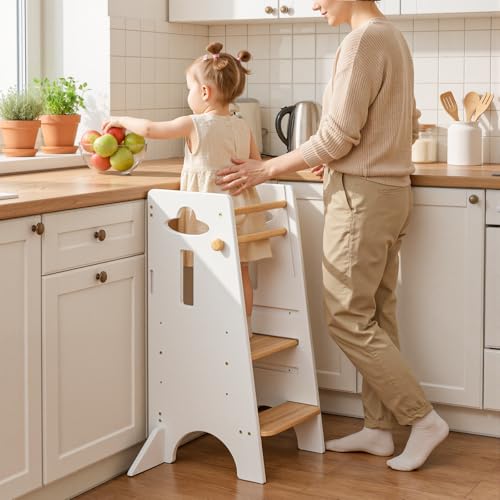
The wide back panel is what makes most towers feel like a cage; this one skips it.
Best for: parents who want a rail without a wide back panel blocking sight lines Skip it if: you want a folding tower for a small kitchen
This COSYLAND stands 35.4 in tall on a 17.7 × 15.7 in base. The listing calls out that there is no wide back panel and that the round rail is removable, which gives you a clear line of sight to your child and a way to lift them out from any side. COSYLAND says the board is 0.6 in thick and puts the total weight "over 20 lb", the heaviest here after the Ocodile.
Three platform heights adjust as your child grows, which is the highest number of levels in this set: the HBTower and OMEW list none, the labebe lists none, and the other COSYLAND lists two. That adjustability, combined with the open-back rail, is why this earns its price position at the premium end. The trade-off is that it neither folds nor converts. It stakes out a permanent corner and asks you to like it there. Against the sister COSYLAND further down the list, this one wins on rail geometry and platform levels; the sister wins on folding.
Pros:
- Three-level adjustable platform
- Removable round rail, no back panel
- 0.6 in board and 20 lb-plus body
- Clear sight lines from the parent side
Cons:
- Does not fold flat
- Premium price band for a non-folding tower
- No published weight capacity
- One of the two heaviest picks here
4. labebe Foldable Standing Tower — Best budget pick
The labebe is the cheapest way to test whether a learning tower belongs in your kitchen.

Best for: first-time buyers testing whether a tower fits daily life Skip it if: you need bamboo or a stated weight limit
It sits at the bottom of the price range and still gives you a 4-in-1: standing tower, drawing station, blackboard, and a folded table-and-chair configuration. Weight is 13.4 lb, tied with the folding COSYLAND for the second-lightest here. The footprint is 25.6 in wide by 12.6 in deep, which is the widest and the shallowest base in this set: a shape that helps you slide it against a wall between uses.
labebe says the frame is MDF with an anti-tipping design, and the listing highlights the Montessori-inspired setup. The compromise is what the listing does not say: no capacity number, no published platform height, no adjustment levels. Compared to the OMEW at the top, the labebe gives you a similar conversion trick for less money, but on MDF rather than solid wood, and it sells more slowly than the rest of this set. That last part matters less than it sounds: newer listings often trail on volume. Treat this as the pick that lowers your regret if the tower turns out not to fit your routine.
Pros:
- Entry price, the cheapest of the six
- 4-in-1 with blackboard and folded configuration
- 13.4 lb, one of the two lightest
- Shallow 12.6 in depth against a wall
Cons:
- MDF rather than solid wood or bamboo
- No stated capacity or adjustment levels
- The slowest seller of the six
- 25.6 in width needs the wall space
5. COSYLAND Foldable Toddler Tower — Best for pros
When a listing says the folded depth is 0.01 in, it means the tower goes flush to the wall.

Best for: small kitchens where the tower has to disappear between meals Skip it if: you prefer three platform heights over two
Folded dimensions on the listing read 0.01 × 16.7 × 35.4 in, which is the pack-away figure that decides the buy for people whose only free wall is behind a door. Weight is 13.5 lb, effectively tied with the labebe and the HBTower. COSYLAND says the frame is bamboo with a widened stabilising foot and a CPC certification, and calls out a safety net rather than solid rails on all four sides.
Two platform heights cover an age range the listing calls 18 months to 6 years. That is one level fewer than the other COSYLAND, and the trade-off buys you the folding hinge. Assembly is described as guided by labelled parts and numbered screws, which matters more than it sounds: the pros in the section title are the parents who have already assembled one tower and know how much of a fight the last step can be. Against the labebe, this pick loses on price and gains on material; against the sister COSYLAND, it gains on folding and loses one adjustment level.
Pros:
- Folds to 0.01 in stated depth
- Bamboo A-frame with widened feet
- Two-level platform, 18 months to 6 years claim
- Guided assembly, labelled hardware
Cons:
- Two levels rather than three
- Mid price band without a table-and-chair mode
- Uses a safety net rather than full rails
- The rear opening reads as tight for taller toddlers
6. Ocodile Toddler Tower with Sliding Door — Best premium
A sliding door means the child climbs in from the side rather than lifting a leg over a rail.

Best for: curious climbers who benefit from a sliding-door entry Skip it if: you want the lowest weight or the smallest base
The Ocodile weighs 24.9 lb on a 17.7 × 15.7 in base, 35.5 in tall. It is the heaviest of the six by a clear margin, and its price sits at the top of this set. Ocodile lists three adjustable platform heights, a 150 lb capacity claim, textured non-slip steps, and a sliding-door side entry that no other pick here offers. The listing calls it a 2026 design and specifies black floor-protection pads in the box.
The case for spending here is the sliding door. Toddlers who fight the entry step, or who scramble at the rail, get a clearer path in and out, and the parent gets a hand free during the climb. Compared to the OMEW, you give up the table-and-chair conversion and 8.9 lb of extra weight in exchange for the door and a third adjustment level. Against the two lightest picks, you give up portability entirely. If the tower will live in one corner and be used daily, the door pays back the price position; if it moves around the room, look elsewhere.
Pros:
- Sliding-door side entry, unique in this set
- Three adjustable platform heights
- Textured non-slip steps
- 150 lb stated capacity
- Floor-protection pads included
Cons:
- 24.9 lb, the heaviest here
- Most expensive pick in this set
- Does not fold or convert
- 150 lb capacity is lower than the HBTower claim
How much floor space will one eat?
The published footprints tell you more than the ages do. Sorted by base area:
- labebe: 25.6 × 12.6 in — widest, shallowest, folds flat
- OMEW: 22.6 × 18 in — largest total area, converts to table and chair
- HBTower: 16.5 × 17.7 in — narrow and boxy, does not fold
- COSYLAND foldable: 16.7 in wide, folds to 0.01 in deep
- COSYLAND round-rail: 17.7 × 15.7 in — smallest permanent base
- Ocodile: 17.7 × 15.7 in — same base as the COSYLAND round-rail, heavier body
Read this against your galley: a 17.7 in base clears most cabinet toe-kicks and sits inside a standard 24 in aisle without cutting the walking path. A 22.6 in base leaves roughly 15 in of clearance in a 36 in kitchen aisle, which is enough to pass but not enough to open the dishwasher next to it.
Rule of thumb: if your kitchen has no permanent home for a 17 in-square object, buy a tower that folds. That means the labebe or the folding COSYLAND.
Folding, converting, adjusting: which feature matters?
These three words sound similar and mean different things.
- Folding collapses the frame flat for storage. Only the labebe and the folding COSYLAND do this.
- Converting rearranges the frame into a different piece of furniture. The OMEW and the labebe both claim a table-and-chair mode.
- Adjusting changes the platform height while the tower stays assembled. The COSYLAND round-rail and the Ocodile list three levels; the folding COSYLAND lists two; the OMEW, HBTower and labebe list none.
If you rank these, put adjusting first for children under two who will grow into the tower. Put folding first for kitchens under 80 square feet. Put converting first for households that want the piece to earn its keep at snack time as well as cooking time. Only the labebe hits two of the three at once, which is the case for its budget position despite the MDF build.
What the listings do not tell you
The specifications you get are honest as far as they go, but a learning tower has three variables that no product page publishes.
Platform height above the floor. Every tower here lists an overall height around 33 to 35 in, but that is the top of the rail, not the top of the standing platform. Without the platform figure, you cannot check whether your child's chest will clear a 36 in counter. Measure your counter and ask the seller before you buy if this matters.
Rail height above the platform. The gap between where the child stands and where the rail catches them decides whether a leaner falls out. Photos help; numbers would help more.
How the tower behaves on soft floors. Every pick here is tested on hard surfaces in its photos. On a rug, a wide base rocks more than a narrow one, and floor-protection pads add height. The Ocodile is the only pick that lists pads in the box.
Ask the seller for the platform height. Any listing that answers within a working day is worth trusting on the rest of the numbers too.
The verdict
The best toddler learning tower is the OMEW 4-in-1 Toddler Standing Tower. It gives you the widest usable A-frame base in the set at 22.6 × 18 in, solid wood and MDF rather than particleboard or thin plywood, and a clip system that turns the tower into a table and chair for the hours your child is not cooking with you. Sixteen pounds is heavier than the bamboo picks by roughly 2.5 lb, and the OMEW does not publish a weight capacity, but the versatility earns the mid-range position more clearly than any other pick here does.
Two conditions flip the recommendation. If you need the highest stated capacity in the set, the HBTower's 450 lb claim on a 13.3 lb bamboo frame is the pick, and the entry price makes the decision easy. If your kitchen has no permanent corner for a 17 in-square object, the folding COSYLAND collapses to 0.01 in of stated depth and lives behind a door, and the labebe does the same at the bottom of the price range. The Ocodile earns its premium position only if the sliding-door entry solves a real problem your child has at the rail.
FAQ
Is a toddler learning tower worth it?
A toddler learning tower is worth it in kitchens where the child is already trying to climb onto a chair to reach the counter. It replaces an unstable chair with a rail on four sides and a wide base. If your child is content on the floor with their own bowl, the tower is optional. The picks in this set weigh 13.3 lb to 24.9 lb and stand 33 to 35.5 in tall.
How is the OMEW different from the labebe?
The OMEW differs from the labebe in three ways that decide the choice. The OMEW is solid wood and MDF at 16 lb on a 22.6 × 18 in base and converts using a clip system. The labebe is MDF at 13.4 lb on a 25.6 × 12.6 in base and folds. Both include a blackboard. The OMEW sits in the mid price band; the labebe is the cheapest of the six.
What height counter does a toddler learning tower fit?
The height a toddler learning tower fits depends on the platform, not the overall frame. Every pick here stands 33 to 35.5 in at the rail, but the standing platform is lower. Standard kitchen counters run 36 in tall. A tower that raises a child roughly 15 to 18 in above the floor puts most toddlers at counter height. Ask the seller for the exact platform height before you commit.
Which learning tower folds the flattest?
The folding COSYLAND folds the flattest of the six, with a listed folded depth of 0.01 in. That is a spec that reads as "flush to the wall". The labebe also folds and converts into a table-and-chair mode, but its folded depth is not published. The other four picks, including the OMEW, the HBTower, the round-rail COSYLAND and the Ocodile, do not fold at all.
What should I avoid in a toddler learning tower?
Avoid a toddler learning tower with a narrow base for its height, no stated adjustability for a child under two, and no clear published dimensions. A frame taller than 35 in on a base under 15 in wide has a poor width-to-height ratio. A listing without a full width, depth and height figure is a listing that has not been finished. Every pick in this set publishes all three.
The next step is to measure the corner where the tower will live, then match the base of your top pick against that number before you order. If the corner is under 17 in on the short side, the folding picks decide themselves. If you have a full 22 in to spare, the OMEW earns the space back by turning into a table when the cooking is done, which is the trick none of the other five towers in this set can quite match. Bamboo, sliding doors and third adjustment levels are real advantages, but only the OMEW gives you a piece of furniture that stays useful when your child climbs down.