Best Chicken Waterers for Clean, Cool Coop Water

Six chicken waterers compared by capacity, drinker style and coop fit. Omlet's insulated 3-gallon model leads, with cheaper and larger options where they earn it.

By Travis WaltersUpdated 15 min read
On this page
- Best chicken waterers at a glance
- How I narrowed six waterers from a crowded field
- Cups, nipples or open trough: what actually decides it
- How many birds does each capacity really cover?
- 1. Omlet Insulated Chicken Waterer — Best overall
- 2. Lil'Clucker Large Automatic Chicken Waterer Cups — Best upgrade
- 3. FARM-TUFF Premium 5-Gallon Hanging Chicken Waterer — Best for families
- 4. ZINZINULER Automatic Port Chicken Feeder and Cup Waterer — Most versatile
- 5. FARM-TUFF Galvanized Poultry Waterer — Best minimal setup
- 6. Little Family Members Chicken Waterer 1.5-Gallon Metal Handle — Best budget pick
- What the listings do not tell you about winter
- Which waterer fits your coop layout?
- The verdict
- FAQ
The best chicken waterers here are led by the Omlet Insulated Chicken Waterer, a 3-gallon sage-green unit that ships with five cups and five nipples and, per Omlet, blocks 99% of light to slow algae. If you already own a food-safe bucket, the Lil'Clucker 5-Pack of automatic cups turns it into a bigger reservoir for less outlay, and it is the second-cheapest pick here.
Most backyard keepers pick a waterer by gallons and regret it within a season. A 5-gallon jug that grows algae in July is worse than a 3-gallon one that stays clean. The real cost of getting this wrong is a slimy green reservoir, wasted feed from wet crumble, and a flock drinking less than it should in the heat.
Best chicken waterers at a glance
| Pick | Capacity | Drinker style | Price |
|---|---|---|---|
Best overall Omlet Insulated Chicken Waterer |
3 gal | 5 cups + 5 nipples | Check Price |
Best upgrade Lil'Clucker Automatic Waterer Cups |
Your bucket | 5 cups | Check Price |
Best for families FARM-TUFF 5-Gallon Hanging Waterer |
5 gal | Gravity trough | Check Price |
Most versatile ZINZINULER Feeder and Cup Waterer Set |
15.4 x 9.2 x 6.4 in | Cups (feeder + waterer) | Check Price |
Best minimal setup FARM-TUFF Galvanized Poultry Waterer |
5 gal | Open drinking lip | Check Price |
Best budget pick Little Family Members 1.5-Gallon Waterer |
1.5 gal | Open trough | Check Price |


How I narrowed six waterers from a crowded field
The category is crowded with near-identical jugs, so I worked from the published listing data and cut on three criteria in order.
- Drinker type has to be stated. Cups, nipples, an open trough or a lip. If the listing did not commit, I cut it. Every pick here names its drinker style.
- Capacity and dimensions have to be published. A "large" waterer without a gallon figure or a footprint is a waterer you cannot plan a coop around. Every pick here carries either a gallon capacity or a full dimension figure.
- The build material has to be named. BPA-free plastic, galvanised steel, or metal handle: each has different implications for winter and cleaning. If the listing was vague on material, I cut it.
That left six units that cover the real range of choices a backyard keeper faces: a premium insulated jug, a metal galvanised classic, two gravity-fed plastic jugs at different sizes, a cup conversion kit, and a hanging feeder-and-waterer combo. Between the six, price positions run from the cheapest of the set at 0.79 lb to the most expensive at 7.72 lb, and reservoir capacity runs from 1.5 gal up to 5 gal.
Cups, nipples or open trough: what actually decides it
The obvious specification is capacity. It is not what decides the best chicken waterers for a real coop. The drinker style does.
- Open trough or lip. Cheapest to buy, easiest to fill, dirtiest fastest. Bedding, droppings and feed all end up in the water. Fine for brooders and small flocks with daily attention.
- Cups. A small reservoir refills as birds drink. Water stays cleaner because the pool is tiny, and the birds learn cups faster than nipples. The trade-off is more moving parts to clean.
- Nipples. Cleanest of the three by a long way. Nothing drops in. Birds have to peck a metal pin, which chicks pick up in a day or two but older hens sometimes resist for a week.
Two of the six picks give you a choice. The Omlet ships with both cups and nipples so you can switch. The Lil'Clucker set is cups only, but at a low price position that assumes you already own the bucket. If you are buying your first waterer and cannot decide, the ability to swap is worth paying for.
How many birds does each capacity really cover?
A rough rule most keepers use: a hen drinks about a pint a day in mild weather, and roughly double that in a hot spell. That turns the gallon figures on these listings into a planning number rather than marketing copy.
- 1.5 gal covers a small flock or a brooder run.
- 3 gal covers a mid-sized backyard flock through a hot day without refilling.
- 5 gal covers a larger flock, ducks included, or a mid-sized flock over a weekend away.
The Little Family Members waterer sits at 1.5 gal and 0.79 lb empty, which is the lightest here. The Omlet at 3 gal weighs 7.72 lb empty, which tells you the insulation is doing real work. The two FARM-TUFF jugs are both 5 gal, but the galvanised model weighs 7.4 lb and the plastic model weighs 3.18 lb. That weight gap is your winter clue: metal survives freeze-thaw cycles, thin plastic can split.
1. Omlet Insulated Chicken Waterer — Best overall
The Omlet is the only pick here that ships with both cups and nipples and publishes an insulated body.
Best for: small backyard flocks that need clean water in hot summers Skip it if: you keep more than a dozen birds and refill only twice a week
At 3 gal, this is not the largest reservoir in the set, and it sits at the most expensive price position of the six. What you buy with the extra outlay is the combination no other pick here matches. Omlet says the insulation keeps water cool in summer and helps prevent freezing in winter, and that the sage green shell blocks 99% of light to stop algae. The waterer ships with five cups and five nipples, so you can start with cups, switch to nipples later, and keep the other set as spares. The anti-roost lid handles the classic problem of a hen deciding your waterer is her perch. At 7.72 lb empty, it is one of the heavier picks here, which reads as insulation rather than filler. The trade-offs are real: it is the priciest of the six, and 3 gal is smaller than either FARM-TUFF, so a large flock will refill more often. In this set, though, no other pick combines light-blocking, insulation and a choice of drinker.
Pros:
- Insulated body, per Omlet, cools in summer and slows freeze
- Ships with five cups and five nipples
- Anti-roost lid keeps the top clean
- Sage green shell blocks 99% of light per Omlet
- BPA-free and UV-stable plastic
Cons:
- Most expensive pick here
- 3 gal is smaller than the FARM-TUFF options
- Heaviest plastic option at 7.72 lb empty
2. Lil'Clucker Large Automatic Chicken Waterer Cups — Best upgrade
A five-pack of cups that turns a bucket you already own into a cup-based waterer.

Best for: keepers already using a bucket who want to convert it into a cup waterer Skip it if: you do not own a drill or a spare food-safe bucket
This is the cheapest cup-drinker route in the set and the second-cheapest pick overall. You supply the reservoir. Lil'Clucker supplies five orange automatic cups and, per the listing, an installation that needs 3/8-inch holes drilled into a container or a 5-gallon bucket. Because you are choosing your own bucket, this is the only pick here whose capacity is up to you: a 2-gallon pail for a brooder, a 5-gallon bucket for a bigger flock. The count of five cups is generous. Most keepers space two or three cups around one bucket, so a single pack can service two waterers or leave you with spares. The trade-off is the setup: you need a drill, a food-safe bucket, and a willingness to test the seal before filling. It is not a plug-and-play buy. But if you already have a spare bucket in the shed, this is the cheapest way to move from an open trough to a cup system, and cups are what keep water cleanest between refills.
Pros:
- Second-cheapest pick in the set
- Five cups per pack service one or two buckets
- Reservoir size is your choice
- Simple 3/8-inch hole install per Lil'Clucker
- Works for chickens, ducks, turkeys and rabbits per listing
Cons:
- No reservoir included
- Needs a drill and a food-safe bucket
- No published weight or dimensions for the cups
3. FARM-TUFF Premium 5-Gallon Hanging Chicken Waterer — Best for families
A 5-gallon gravity-fed plastic jug with a top-fill opening, sized for mixed flocks.

Best for: mid-sized flocks that also include ducks or turkeys Skip it if: you need a lid that blocks light for algae control
This is the larger and lighter of the two 5-gal picks: 3.18 lb empty against the galvanised model's 7.4 lb. The listing says the body is BPA-free plastic with a wide top-fill opening for quick refills and cleaning, and the drinker is a gravity trough that ducks and turkeys can actually get their bills into. That last point matters. Nipples and small cups suit chickens better than waterfowl, and if your yard is mixed, an open trough is often the only workable choice. FARM-TUFF includes one spare replacement cap, which is a small nod to long-term use. Where it loses to the Omlet is light control: the red opaque plastic is not marketed as light-blocking, and in a sunny run you will scrub it more often. It sits at a mid price position in the set. If your flock is chickens-only and you have shade, the Omlet's cleaner water is worth the step up. If you keep ducks, this is the pick.
Pros:
- 5 gal capacity for mid-sized flocks
- Suits chickens, ducks and turkeys per listing
- Top-fill opening simplifies refilling
- Light at 3.18 lb empty
- Spare replacement cap included
Cons:
- No published light-blocking claim
- Open trough collects debris faster than cups
- No stated warranty
4. ZINZINULER Automatic Port Chicken Feeder and Cup Waterer — Most versatile
A hanging feeder-and-waterer pair, sold together, that mounts on a coop rail or wire fence.

Best for: keepers who want a feeder and waterer that hang from the same rail Skip it if: you prefer a single high-capacity reservoir over two smaller units
The only combo in the set. ZINZINULER ships a port feeder that the listing says holds up to 16 pounds of feed, alongside a cup waterer, both cyan, both designed to hang. The full unit measures 15.4 x 9.2 x 6.4 in, which is compact enough for a small coop wall. The feeder has a lid, which the listing says keeps feed sanitary, and the cups run on the same automatic principle as the Lil'Clucker set: a small drinking pool refills as birds use it. The count of 2 in the specifications reflects that you get both items in one purchase. This is a mid price position, and the appeal is layout rather than pure capacity: one rail, one system, feed and water together. The trade-off is that the waterer is smaller than either 5-gal option here, and neither reservoir carries a published gallon figure. If you have a small flock and want to buy feed and water hardware once, it works. For a big flock, look elsewhere.
Pros:
- Feeder holds up to 16 lb of feed per listing
- Hangs on a wire fence or wall per listing
- Feeder lid keeps feed covered
- Compact 15.4 x 9.2 x 6.4 in footprint
- Sits at a mid price position
Cons:
- No published gallon capacity for the waterer
- Two smaller units in place of one large reservoir
- Cup mechanism needs occasional cleaning
5. FARM-TUFF Galvanized Poultry Waterer — Best minimal setup
The only metal waterer here, and the only pick with a published warranty entry.

Best for: keepers who want galvanised steel and an open drinking lip Skip it if: your coop floor is uneven or you need to hang the waterer
Galvanised steel, 5 gal, 7.4 lb empty, and a cone top that the listing says stops birds roosting on it. This is the traditional farm waterer that has not needed a redesign in decades. The listing describes double-wall vacuum-sealed construction, which keeps the drinking lip filled at a constant level as the reservoir empties. The 16.5 x 16.5 x 16.5 in footprint asks for a flat surface: the listing is explicit that it is not designed for hanging, and the drinking lip is 1.5 in wide. It sits at the second-highest price position in the set, ahead of the plastic 5-gal FARM-TUFF and behind only the Omlet. The pull is durability rather than features. Steel outlasts plastic in freeze-thaw cycles, and rolled seams resist dents. The trade-offs: the cone top does not double as a light block the way an opaque insulated lid does, and setting it down on a lumpy dirt floor gives you a wobble. It is also the only pick here whose listed category is fountains rather than poultry supplies, which is worth knowing when comparing to alternatives.
Pros:
- Galvanised steel with rolled seams
- 5 gal capacity for larger flocks
- Cone top prevents roosting per listing
- Double-wall vacuum-sealed design
- Only pick with a warranty entry on the listing
Cons:
- Flat surface only, no hanging
- No published light-blocking or insulation claim
- Second-most-expensive pick here
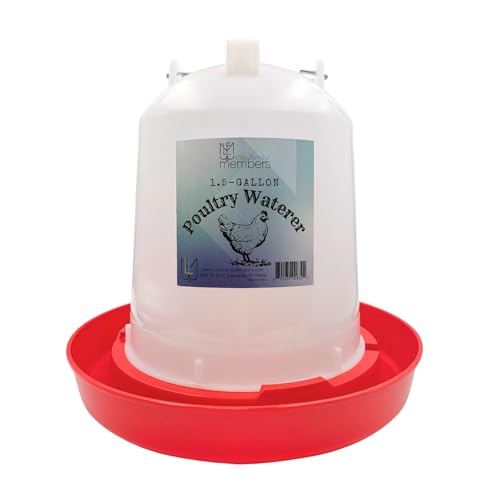
6. Little Family Members Chicken Waterer 1.5-Gallon Metal Handle — Best budget pick
The cheapest pick in the set, and the lightest at 0.79 lb empty.
Best for: brooders and starter flocks under six birds Skip it if: your birds knock light waterers over
At 1.5 gal, this is the smallest reservoir in the set. Little Family Members lists the footprint at 8 x 12 x 12 in and highlights an improved solid base to reduce leaks, plus a metal handle for carrying and hanging. It is a plastic body with a narrow open trough, the classic first-flock design. The price position is the cheapest of the six, and the light weight, 0.79 lb empty, is what a new keeper wants when they are refilling twice a day and moving the waterer between run and coop. The trade-off is stability and cleanliness. A 0.79 lb empty body full of water still weighs less than the Omlet empty, and an energetic hen can rock it. The open trough collects bedding faster than any cup system in this set. Use it in a brooder or with a small flock, and step up once you scale. For its price position, it does the basic job.
Pros:
- Cheapest pick in the set
- Lightest at 0.79 lb empty
- Metal handle for carrying and hanging
- Solid base to reduce leaks per listing
- Works for chicks and mature birds per listing
Cons:
- 1.5 gal reservoir is smallest here
- Open trough collects debris
- Light body can be knocked over by larger hens
What the listings do not tell you about winter
Winter is where cheap chicken waterers fail. Two things happen. Water freezes overnight, and thin plastic cracks along its seams when it does. Only two picks in this set publish a winter-relevant claim.
The Omlet listing says the insulated body helps prevent freezing. That is not a guarantee against a hard freeze, and no plastic waterer at this price bracket is heated. What it buys you is time: an insulated 3 gal reservoir stays liquid longer than a bare 3 gal jug in the same coop. The FARM-TUFF Galvanized has the other winter answer: metal. Galvanised steel handles freeze-thaw cycles that split plastic. Neither is a substitute for a heated base in a hard-winter climate, but both push the point at which you need one.
The three plain plastic picks, the FARM-TUFF 5-gal, the Little Family Members and the ZINZINULER combo, do not publish freeze claims. In a mild-winter yard they are fine. In a place that sees weeks below freezing, plan for a heated base, or accept that you will be swapping the frozen unit for a spare each morning.
Which waterer fits your coop layout?
Capacity is only useful if the waterer actually fits where you want to put it. Two picks here are designed to hang, one is explicitly not, and the rest sit on the floor.
- Hanging: the Lil'Clucker cups (on any bucket you hang), the ZINZINULER combo, and the FARM-TUFF plastic 5-gal.
- Floor only: the FARM-TUFF Galvanized. The listing states it is designed for flat surfaces and is not for hanging.
- Either: the Omlet and the Little Family Members, which sit on the ground but also carry handles or mounting options.
Hanging keeps water clean because bedding cannot kick into it. Floor-mounted waterers gather more debris but suit brooders and chicks that cannot reach a hung reservoir. If your coop is small and your birds are dust-bathers, hang what you can.
The verdict
If your coop is a backyard setup with a small flock and hot summers, the Omlet Insulated Chicken Waterer is the right buy. The combination of an insulated body, a shell that blocks 99% of light per Omlet, and a choice between five cups and five nipples is the cleanest water setup in this set. It is the most expensive pick here, and its 3 gal reservoir is smaller than either FARM-TUFF, but the daily result is water that stays drinkable through a July afternoon.
The cutoff is your flock size. Below roughly six or eight birds in a mild climate, the Omlet wins on water quality. Above that, and especially with ducks or turkeys in the mix, the FARM-TUFF 5-Gallon Hanging Waterer's extra 2 gal and open trough matter more than light-blocking. And if you already own a food-safe bucket and a drill, the Lil'Clucker cup kit is the cheapest route to cup-clean water at any capacity you like. Three picks, three profiles, one cutoff: flock size and drinker type do the deciding, not gallons alone.
FAQ
Are chicken waterers with cups better than nipples?
Chicken waterers with cups are easier for birds to learn, because the small pool of water is visible. Nipples take a few days for mature hens to pick up, but they keep water cleanest because nothing drops in. The Omlet ships with both, so you can start on cups and switch to nipples once your flock is trained. Choose cups for speed of adoption, nipples for cleanliness.
Is it worth paying more for an insulated chicken waterer?
Paying more for an insulated waterer is worth it if your summers run hot or your winters dip below freezing. The Omlet is the only pick here whose listing publishes an insulation claim, and it sits at the most expensive price position in this set. The insulation slows algae growth in heat and delays freezing overnight. In a mild climate with shade, a plain plastic 5-gal jug covers the same duty for less.
How many chickens does a 5-gallon waterer serve?
A 5-gallon waterer serves roughly fifteen to twenty birds through a hot day, using the common backyard estimate of about a pint per hen daily and double that in a heatwave. The FARM-TUFF plastic 5-gal at 3.18 lb empty and the FARM-TUFF Galvanized at 7.4 lb empty both hit that mark. For smaller flocks under six birds, a 1.5 gal or 3 gal reservoir refills less often than a large one grows algae.
Omlet or FARM-TUFF: which is better for a mixed flock?
For a mixed flock with ducks or turkeys, FARM-TUFF is better because its open trough suits the wider bills that struggle with cups and nipples. The Omlet's cup-and-nipple drinkers are chicken-shaped. If your flock is chickens only, Omlet's light-blocking shell and insulation win on water quality. The deciding question is not price, it is whether any bird in the yard has a bill that cannot use a cup.
What is the biggest mistake buying a chicken waterer?
The biggest mistake buying a chicken waterer is picking on capacity alone. A 5 gal jug that grows algae in three days is worse than a 3 gal one that stays clean for a week, because a slimy reservoir kills water intake. Look at the drinker style first, then the light and material, then the gallons. Cups and nipples beat open troughs on cleanliness in almost every coop.
Setting up a chicken waterer is a decision you make once a season and live with every morning, so pick for the ninety worst days of your year, not the mild ones. In a small backyard flock, the Omlet Insulated Chicken Waterer earns its price position with insulation, a light-blocking shell and a choice between cups and nipples that no other pick here offers. Order it in the size that matches your flock today, keep the second drinker set as spares, and put it on a level patch of coop floor before the first hot week arrives. If your flock is bigger or your birds include ducks, start with the 5-gallon FARM-TUFF instead and add cups later.