Best Budget Kids Binoculars for Backyard Explorers
A shortlist of five kid-friendly binoculars compared by magnification, weight and fit, with a clear winner for ages 3 to 12 and an upgrade pick for older children.

By Travis WaltersUpdated 14 min read
On this page
- Best budget kids binoculars at a glance
- How I narrowed five listings down
- 1. Scotamalone Kids Binoculars Shock Proof Toy Binoculars Set — Best overall
- 2. Educational Insights GeoSafari Kidnoculars — Best upgrade
- 3. ARTOMIDE Kids Binoculars Ages 3-12 with Compass & Whistle — Most versatile
- 4. Hontry 10x25 Compact Binoculars for Adults and Kids — Best for families
- 5. Occer 12x25 Compact Binoculars for Adults and Kids — Best premium
- Magnification numbers, and why 4x can beat 12x for kids
- How small hands actually hold a pair
- What to check before you hand a pair to a three-year-old?
- Which pick fits which age?
- What the listings quietly leave out
- The verdict
- FAQ
The best budget kids binoculars are the Scotamalone 4x30 set, because at 3.63 oz with rubber-armoured eyepieces they suit a three-year-old's grip and face without punishing a parent's patience. For toddlers still learning to focus, the Educational Insights GeoSafari Kidnoculars are the better call: 2x magnification, no focus wheel to fight, and a 7.05 oz body built for small hands. Everything else in this roundup fits somewhere between those two anchors.
Best budget kids binoculars at a glance
| Pick | Magnification | Weight | Price |
|---|---|---|---|
Best overall Scotamalone Kids Binoculars Shock Proof Toy Set |
4x30 | 3.63 oz | Check Price |
Best upgrade Educational Insights GeoSafari Kidnoculars |
2x, focus-free | 7.05 oz | Check Price |
Most versatile ARTOMIDE Kids Binoculars with Compass & Whistle |
5x claim | 5.29 oz | Check Price |
Best for families Hontry 10x25 Compact Binoculars |
10x25 | 0.6 lb | Check Price |
Best premium Occer 12x25 Compact Binoculars |
12x25 | 0.86 lb | Check Price |



How I narrowed five listings down
I lined up every listing on the same two axes: what the child physically holds, and what the child actually sees through the lens. Most kid-marketed binoculars fail on the first one. A pair that weighs 0.86 lb looks light on paper, and then a five-year-old holds it up for thirty seconds and their arms drop.
Three cuts shaped the shortlist. First, anything with published weight above one pound was out for the youngest kids' picks. Second, anything without rubber-armoured eyepieces stayed off the "toddler-safe" recommendations, because a hard plastic ring meets a face at speed the first time a child trips. Third, the magnification claim had to line up with the age band on the box: a 12x pair sold as "for kids and adults" is really for the adult, and I've flagged it that way.
What survived is a set of five that splits cleanly. Two picks are toys with lenses. Three are compact binoculars a child can share with a parent. The winner is the lightest of the bunch, and that isn't an accident.
1. Scotamalone Kids Binoculars Shock Proof Toy Binoculars Set — Best overall
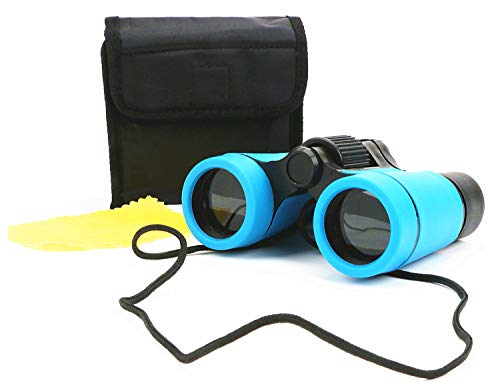
The Scotamalone 4x30 is the pick to buy first, because it's the only one under 4 oz with rubber-armoured eyepieces and a proper carry kit.
Best for: ages 3 to 12 heading into the backyard or on a first hike Skip it if: you want optical glass and a serious magnification for a nine-year-old birder
At 3.63 oz and 1.81 x 4.76 x 4.33 in, this is the smallest and lightest pick in the set, which matters more than any spec sheet suggests. A small child can hold these to their face without their elbows collapsing, and the 4x magnification is easy for a young eye to track a moving bird with. The listing describes non-toxic rubber armour around the eyepieces and includes a canvas bag, a neck strap and a lens cloth, so you're not buying accessories separately. Scotamalone lists a 1-year warranty, which is more than two of the compact adult-style picks publish. The trade-off is honest: 4x magnification is a toy-grade figure, and older kids who already own a scope will find it modest. Against every other pick here, though, it's the only one that combines a published warranty, the lowest weight and full kit at the entry price position.
Pros:
- Lightest in the set at 3.63 oz
- Rubber-armoured eyepieces around the face
- Canvas bag, strap and cloth included
- 1-year warranty published
- Adjustable focus knob for children's eyes
Cons:
- 4x magnification is modest for older kids
- Field of view not stated on the listing
- Single seller lists it
2. Educational Insights GeoSafari Kidnoculars — Best upgrade
Kidnoculars are the pick for a two- or three-year-old, because there is no focus wheel to fight and the eyepiece is oversized on purpose.

Best for: toddlers who need focus-free simplicity and an oversized eyepiece Skip it if: your child is already comfortable adjusting a real focus wheel
Educational Insights takes a different approach from every other pick here: 2x magnification, no focus adjustment, and a body that measures 2.8 x 7 x 5.75 in with a large single eyepiece rather than two barrels a toddler has to align. At 7.05 oz it's heavier than the Scotamalone, but the breakaway neck strap carries the weight, and the shape is designed for a face still working out where its eyes are. The listing states a 1-year warranty against manufacturer defects, which matches the Scotamalone and puts both toy-grade picks ahead of two of the compact options on that measure. The listing also names the age band as 3+ and positions the product as a first pair for preschool. Where it loses ground: 2x is the lowest magnification here, so a five- or six-year-old will outgrow it inside a season. That is the trade-off you accept for a focus-free design.
Pros:
- Focus-free, no wheel for small hands
- Extra-large 2x eyepiece
- Breakaway neck strap included
- 1-year warranty against defects
- Two sellers list it, more than any other pick
Cons:
- 2x magnification is easily outgrown
- Heaviest of the two toy-grade picks
- Larger footprint than the Scotamalone
3. ARTOMIDE Kids Binoculars Ages 3-12 with Compass & Whistle — Most versatile
ARTOMIDE earns its place because it bundles a compass and whistle with 5x lenses at the second-cheapest price position here.

Best for: kids who want a compass and whistle in the same kit as the lenses Skip it if: you want a published warranty and a stated field of view
The ARTOMIDE set weighs 5.29 oz, sits between the two toy picks on mass, and claims 5x magnification with a "multi-layer broadband coating" the brand says makes the view more realistic. It's aimed squarely at the 3 to 12 age band. The compass-and-whistle bundle is what shifts the value: a child getting into scouting or a family that does short trail hikes gets a starter kit rather than a single accessory. The listing describes rubber-surrounded eyepieces for face protection, matching the safety story on the Scotamalone. What ARTOMIDE doesn't publish is a warranty, and the dimensions listed on the Amazon page read as inconsistent, which means you're relying more on the brand claims and less on the spec sheet than you are with the winner. In a set where two others quietly ship no warranty at all, that's a shared weakness, but it's still a weakness worth naming.
Pros:
- Compass and whistle included
- 5x claim, higher than the toy-grade picks
- Rubber-surrounded eyepieces
- Second-cheapest of the five
- Aimed at ages 3 to 12
Cons:
- No published warranty
- Field of view not stated
- Listed dimensions look inconsistent
4. Hontry 10x25 Compact Binoculars for Adults and Kids — Best for families
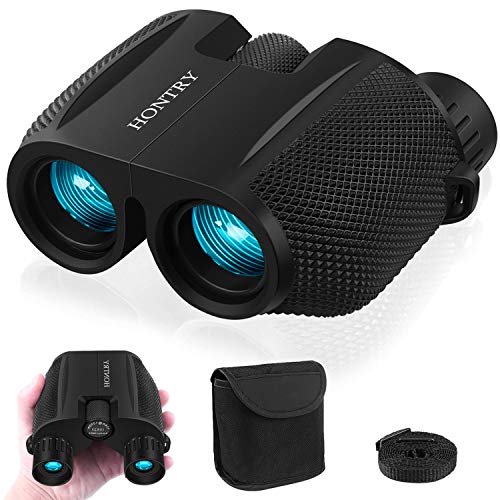
The Hontry 10x25 is the pick when one pair has to work for a parent and a child on the same trip.
Best for: one pair that a parent and a child both use, on the same trip Skip it if: the child is under six and can't hold 0.6 lb steady
Hontry sits in the middle of the compact camp: 10x magnification, 25mm objective lens, a body of 3.94 x 4.33 x 1.97 in and a stated weight of 0.6 lb. Hontry says the interpupillary distance adjusts from 60mm to 75mm, which is the point that matters for a family pair: adult and child eye spacings differ, and a pair that can't close the gap is a pair the child never uses. The brand publishes a 3-year warranty on every unit, the longest in this roundup. Bak-4 prisms are described in the listing. The catch is weight. At 0.6 lb, this is closer to a real compact than a toy, so a small child will need to prop it or sit down to hold a steady image. It's the one buyers choose most often here after the Occer, which speaks to that dual-use appeal.
Pros:
- 3-year warranty, the longest in this set
- Adjustable IPD from 60mm to 75mm
- Bak-4 prisms described in the listing
- 10x25 works for adult use too
- Palm-sized 3.94 x 4.33 x 1.97 in body
Cons:
- 0.6 lb is heavy for a small child to hold steady
- 10x is harder to keep still than 4x or 5x
- Priced in the premium band here
5. Occer 12x25 Compact Binoculars for Adults and Kids — Best premium
Occer is the pick for an older child or a teen who wants reach, and it's the top seller in this set.
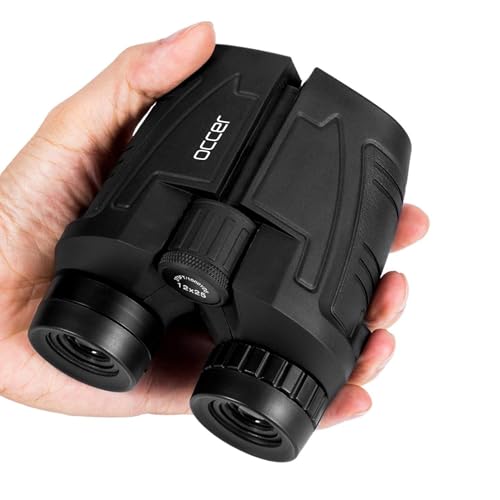
Best for: older kids and teens who want more reach and don't mind the extra bulk Skip it if: a stated manufacturer warranty is important to you
Occer takes the highest magnification in the set at 12x, with a 25mm objective and a claimed field of view of 273 ft at 1000 yds. Weight is 0.86 lb across a 4.4 x 4 x 4 in body, and the listing describes adjustable eye cups that pull down for eyeglass wearers. The rubberised body reads "life waterproof" in the brand's own wording, which is a splash-and-drizzle claim rather than a submersion rating. What tips it into the premium slot is that it's the top seller of the five here, which suggests older kids and adults share it more than the toy-grade picks. The weakness is easy to spot: Occer publishes no warranty on the listing, and 12x magnification amplifies hand shake, so a younger child holding it will see a wobbling image. It's the highest price position in the set for no extra published capability over the Hontry beyond two magnification steps.
Pros:
- 12x magnification, the highest here
- Stated 273 ft field of view at 1000 yds
- Pull-down eye cups for glasses wearers
- Bak-4 prism material described
- The one buyers choose most often here
Cons:
- No warranty published on the listing
- 0.86 lb is the heaviest compact pick
- 12x is hard to hold steady without support
Magnification numbers, and why 4x can beat 12x for kids
Parents shopping for a child usually reach for the biggest number on the box. That is the mistake this category rewards you for avoiding. Magnification is a multiplier on shake as much as on distance: a 12x pair magnifies hand tremor twelve times too, and a six-year-old's hand tremor is not small.
Here is how the numbers in this set map to real use:
- 2x (GeoSafari Kidnoculars). No focus wheel. The child sees a slightly bigger version of what is right in front of them, and they can find the target instantly. Right for ages 3 to 5.
- 4x to 5x (Scotamalone, ARTOMIDE). The sweet spot for ages 3 to 12. Wide enough field of view to find a bird, low enough magnification that the image stays reasonably steady on shaky hands.
- 10x to 12x (Hontry, Occer). Adult figures. A child over eight can enjoy them if they rest their elbows on a picnic table or a fence, and a parent will actually use them for real distance work.
The upshot: the Scotamalone's 4x is not a compromise for a young child. It is the correct answer, and the "premium" 12x figure is a spec for a different buyer.
How small hands actually hold a pair
Weight and shape decide whether the binoculars come out of the bag twice or twenty times. Line up the published weights in this set: 3.63 oz, 5.29 oz, 7.05 oz, 0.6 lb, 0.86 lb. Only the first two are safely under half a pound.
A pre-schooler holds an object to their face using two hands and their neck as a tripod. Anything over 6 oz starts to droop after a short look, and a drooping pair means the child pulls their eyes away from the eyepiece and gives up. That is why the toy-grade picks in this shortlist all weigh less than the compact-adult picks, and it is why the Scotamalone wins overall even though its 4x magnification is the lowest of the traditional binoculars here.
Shape matters too. The GeoSafari's single oversized eyepiece skips the alignment problem entirely: a toddler cannot mis-position two barrels because there is only one to look through. The Hontry's 60mm to 75mm IPD range is the other side of that coin, built for eyes to close together for a child and open wider for a parent. Both approaches are legitimate. What does not work is asking a four-year-old to use a fixed adult-spaced compact pair.
What to check before you hand a pair to a three-year-old?
Check these five things, in order, before your child puts a pair to their face for the first time:
- Eyepiece material. Rubber-armoured is what you want. The Scotamalone, ARTOMIDE and GeoSafari all describe rubber around the eyepieces. A hard plastic ring at speed is what breaks noses.
- Neck strap style. A breakaway strap, like the one Educational Insights describes, releases if the strap catches on a branch or a car door. A fixed strap does not.
- Weight against the child's arms. Have them hold a 6 oz book to their face for thirty seconds before you buy anything over half a pound.
- Focus mechanism. For ages 3 to 5, focus-free (the Kidnoculars) beats a wheel. For ages 5 and up, a centre focus knob is fine, and the Scotamalone describes one.
- What is in the box. A neck strap and a soft bag pay for themselves the first day. The Scotamalone includes a canvas bag, strap and lens cloth; several of the compact picks ship with less.
If any one of those five fails, you'll be buying a second pair inside a month.
Which pick fits which age?
Ages are shorthand, not law, so treat these as starting points and adjust for the child.
- Ages 3 to 5. Educational Insights GeoSafari Kidnoculars. Focus-free, oversized eyepiece, breakaway strap. Skip magnification and buy the ergonomics.
- Ages 4 to 8. Scotamalone 4x30. Lightest pair here, real binocular shape, rubber eyecups, kit included.
- Ages 5 to 10 who want gadgets. ARTOMIDE 5x. The compass and whistle are the reason it sells, and 5x is a small step up from 4x.
- Ages 8 and up who share with a parent. Hontry 10x25. Adjustable IPD closes the gap between a child's eyes and an adult's, and the 3-year warranty is real.
- Ages 10 and up, older kids and teens. Occer 12x25. Real magnification, teen-sized body, but no published warranty and 12x needs a steady surface.
The winner across the whole shortlist is still the Scotamalone, because ages 4 to 8 is the widest single band a kid-binoculars purchase has to cover, and it is the pair that does that band best.
What the listings quietly leave out
Two things are missing from most product pages in this set, and both matter.
The first is field of view. Only the Occer publishes a figure (273 ft at 1000 yds), so on every other pick you're relying on the brand's general description of "wide field of view" without a number. In a category where finding a bird before it flies is the whole point, that is a real gap, and a wider figure at the same magnification is always better than a narrower one.
The second is warranty. The Scotamalone lists 1 year, the GeoSafari lists 1 year, and the Hontry lists 3 years. ARTOMIDE and Occer do not publish a warranty on the listing. That is not proof the manufacturers won't stand behind them; it is proof you should assume nothing beyond the retailer's own return window. If a written warranty matters to you, that alone narrows the best budget kids binoculars shortlist to three: Scotamalone, GeoSafari and Hontry.
The verdict
The best budget kids binoculars for most buyers are the Scotamalone Shock Proof 4x30 set. At 3.63 oz it is the lightest pair here by a clear margin, the 4x magnification suits the 3 to 12 age band it's built for, and the kit includes a canvas bag, neck strap and lens cloth without pushing the price into the premium tier. A published 1-year warranty puts it ahead of two of the more expensive compact options.
Two conditions flip the recommendation. If your child is a toddler and you want a pair with no moving parts, the Educational Insights GeoSafari Kidnoculars are the better call: 2x, focus-free, and an oversized eyepiece that skips the alignment problem entirely. If you want one pair that a parent and a child both use on family trips, the Hontry 10x25 earns it, thanks to a 60mm to 75mm IPD range and a 3-year warranty that is the longest in this roundup. The Occer 12x25 is the reach pick for older kids, and the ARTOMIDE bundle is the pick when the compass and whistle matter as much as the lenses. None of those alternates changes the answer for the average buyer, and the average buyer should start with the Scotamalone.
FAQ
Are the best budget kids binoculars actually worth buying, or are they just toys?
Are the best budget kids binoculars worth it depends on the age of the child. For ages 3 to 8, toy-grade optics at 2x to 5x magnification are the correct answer, because a young child cannot hold higher magnification steady enough to benefit. The Scotamalone and GeoSafari picks earn their place by matching the child's ergonomics. For ages 10 and up, step up to a compact adult pair.
Is a 10x or 12x kids binocular worth the extra money?
Is a 10x or 12x pair worth it only if the child is old enough to hold it still. The Occer 12x25 weighs 0.86 lb and the Hontry 10x25 weighs 0.6 lb, and both magnify hand tremor as much as distance. An eight-year-old resting elbows on a fence can enjoy them. A four-year-old holding them freehand will see a wobbling image and lose interest fast.
What magnification is right for a five-year-old?
What magnification is right for a five-year-old is 4x to 5x, no higher. The Scotamalone's 4x and the ARTOMIDE's 5x claim both sit in this band, giving the child enough reach to see a bird across a garden while keeping the image steady in small hands. Below that, 2x on the GeoSafari suits ages 3 to 4. Above that, image shake takes over.
Scotamalone versus Educational Insights: which pair should I buy first?
Scotamalone versus Educational Insights comes down to age. For a child aged 4 or older who can turn a focus knob, the Scotamalone 4x30 is the better first pair: lighter at 3.63 oz, proper binocular shape, kit included. For a toddler aged 2 or 3, the Kidnoculars' focus-free 2x design and oversized eyepiece are what makes the pair usable at all.
What is the most common mistake parents make buying kids binoculars?
The most common mistake is chasing magnification. A 12x pair looks impressive on the box, but a young child cannot hold it steady, so the image jumps and the child stops using them within a week. The correct answer for ages 3 to 8 is a lightweight 2x to 5x pair with rubber-armoured eyepieces, not the highest number on the shelf.
Take the Scotamalone 4x30 as your default and add a compass-and-whistle set later if the child wants to expand the kit. It is the pair that solves the actual problem: a child under nine who wants to look at a bird, a leaf or a squirrel without dropping something heavy on their toes. If you already own a compact adult pair, the GeoSafari Kidnoculars fills the gap for a younger sibling without duplicating what you have. Either way, start with the ergonomics. Magnification you can trade up to next year. A pair that stays in the drawer teaches nothing.